


NEW YORK — Even though I covered my first U.S. Open 14 years ago, and pride myself on doing in-depth reporting, sometimes I can feel like I’m just scratching the surface of this sport and this tournament.
But on Tuesday evening and Wednesday afternoon at the U.S. Open, I had the opposite sensation, fulfilling a wish that’s been one of my most stubborn tennis-reporting bucket list items: observing the creation of a day’s order of play, and learning everything that goes into this complex and scrutinized process.
After U.S. Open officials agreed to the idea, happily, I was escorted deep within the bowels of Arthur Ashe Stadium into the tournament’s nerve center and inner sanctum to witness one of the most high-profile administrative tasks in the sport.
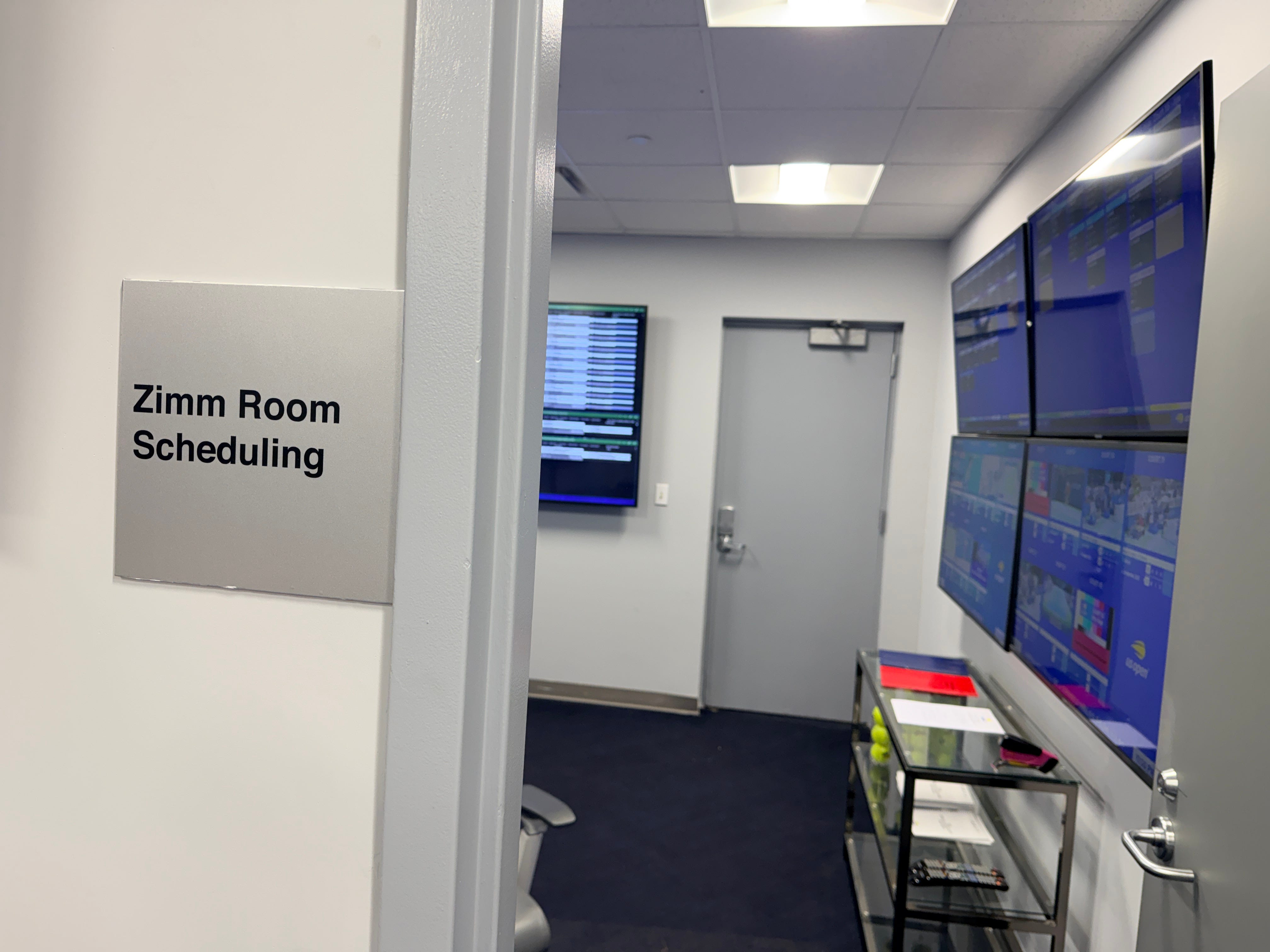
After a brief tutorial on the room and the software, I was a fly on the wall as the work began. U.S. Open referee Jake Garner, U.S. Open tournament director Eric Butorac, Grand Slam supervisor Wayne McKewen, and a rotating cast of other officials put together Thursday’s Day 5 schedule for the U.S. Open, involving 32 second-round singles matches and the start of the women’s doubles event, using 12 large computer monitors—with very small font—and bespoke, purpose-built software.

It was fascinating to hear these administrators talk through their decision-making processes, see the interconnectedness of matches, and understand how star-player requests, broadcaster preferences, rest times, doubles, and more all impact what is put on court each day.
“It’s probably my favorite part of the job, to be honest,” Butorac told Bounces. “I like doing jigsaw puzzles at home, and I feel like this is sort of the ultimate 1000-piece jigsaw puzzle. But you’re playing with a lot at stake.”
Being in this windowless room was hugely illuminating, and I’m excited to bring what I learned to Bounces subscribers. I’ve never written (nor read) a story like this before. If you’re a tennis nerd like me, I think you’re going to love it.
To read the whole thing, please subscribe to Bounces! Still 15 percent off new subscriptions and gift subscriptions during the 2026 U.S. Open! —Ben
Getting Oriented With the Scheduling System
First, Garner gave me a brief tour of the hardware and software used for the daily schedule-making. The software, supplied by SMT, is also used at the Australian Open and Wimbledon.
There are twelve screens in total; the portrait-oriented ones on the outer flanks show the draws. For this task, the most important screens are the four landscape-oriented ones in a 2x2 grid in the middle.

On the lower screens, there are blank fields showing columns for each of 11 courts, defaulting to five rows (matches) per court. If necessary, more courts can be added, but 11 is the base number used for this time of the tournament.
On the upper-left screen, there’s a bank of all the day’s matches to assign called the “palette.” Matches can be clicked and dragged from the palette onto the schedule of matches below. Once on the grid, women’s singles matches are framed in light pink and men’s singles matches are in light blue, so gender balance can be seen at a quick glance.

The upper-right screen features two windows called “Issues” and “Conflicts.” Issues include player requests, which can be made by any player; “Nakashima asked not to play at night” was one for Wednesday. Beyond this formal list, Butorac and other officials from the tournament and tours are in constant contact with players, often in casual conversations, gaining as much understanding as they can about their preferences.
Conflicts can auto-populate when an issue arises like a player who doesn’t have enough rest between matches, either within a day or from the previous day.
Matches are placed onto the schedule in “pairs.” For this phase of the tournament, each second-round match was linked to the other second-round match that would produce third-round opponents. There is an effort to make these paired matches as parallel as possible on the schedule grid, to ensure equitable rest for the two players who advance to the next round. Any time an administrator mouses over one match, its paired match illuminates in green.
There are also ways to pick countries from a dropdown menu and illuminate all the matches featuring players from a given country. This is a chief concern for international broadcasters, who want to show as much of their players’ matches as possible without overlap. One common way this is achieved is by “stacking” matches on one court. For example, by putting two matches featuring Argentines on the same court back-to-back, the tournament ensures that the two matches will be consecutive and won’t overlap with each other.
Requests from the various rights-holding broadcasters around the world are compiled in a Google Doc. Often they relate to time zones. British broadcasters, for example, prefer to have their players in one of the first three slots of the day. British broadcasters also prefer for their players, when possible, to be on one of the five fully-produced television courts (Ashe, Armstrong, Grandstand, Stadium 17, Court 5) which have play-by-play commentators who can be heard on individual court feeds. For countries where English is not the dominant language, world feed commentary is not as important.
With that lay of the land outlined, it was about 9:30 on Tuesday evening, and it was time to start making the Thursday Day 5 schedule.
How the Day 5 Schedule Took Shape
Day 5 would feature the loaded bottom half of the women’s singles draw and the less-loaded top half of the men’s singles draw. The women’s doubles event also begins on that day; its matches will be populated in a later scheduling session.
For reference, here were the 32 singles matches in the palette.
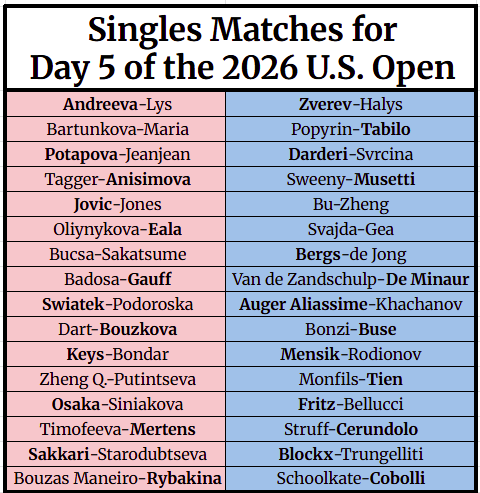
Because of rain and late finishes, not all of these matches were known when the scheduling began. So the schedulers worked, for this first draft, with their best assumptions, assuming that favorites like Alexander Zverev and Iva Jovic would advance. Most did; Rafael Jodar, who lost 6-2, 6-1, 6-1 to lucky loser Bu Yunchaokete on Wednesday, proved a notable exception.
The schedule starts with a solid vision of the first two main stadiums, and then the rest is decided later.
The first move Butorac made without hesitation—having already heard from ESPN about its vision for its broadcast—was putting Gauff into the 7 p.m. slot on Ashe to open the Thursday night session. Gauff had been in the same slot on Tuesday; this would keep her parallel. Also, the most important U.S. Open broadcast slot on Saturday for ESPN is the 3 p.m. window. By putting Gauff in another night session for the second round, the event could plan to put her—should she advance—into an afternoon slot on Saturday.
The top American man, Taylor Fritz, was spotted next. Fritz doesn’t like going first in the morning, they knew, but otherwise is less finicky than other players when it comes to Ashe vs Armstrong. “Fritz could go day; he likes Armstrong,” Butorac said.
Another men’s match jumped out between Learner Tien and Gael Monfils. Monfils-Tien was initially slotted into the second day match on Ashe; Fritz was put on the second day match on Armstrong. “He’s pretty good about not complaining about courts; it’s times he minds,” Butorac said of Fritz.
“This Khachanov-Felix match is good; to me that would be great for Louis,” Butorac continued, slotting the match into the first night slot on Armstrong. There was a desire, he said, to have the sessions on Ashe and Armstrong be inverses of each other. Since Gauff’s match was going first at night on Ashe, then a men’s match should go first at night on Armstrong.
Zverev, who was still on court in Ashe in a first-round match that would drag late into the night, was put in the second slot on Ashe again. This would keep his schedule consistent, Butorac said, and keep his preference for Ashe. Zverev doesn’t mind playing very late, Butorac knows, but wants to be on Ashe whenever possible.
Attention then flipped back to the top women’s offerings. Osaka-Siniakova was called “Ashe-worthy.” Iga Swiatek’s match didn’t have “as strong of an opponent” in Nadia Podoroska, who is currently ranked 449th.
Siniakova posed some challenges, though, Garner pointed out: because she’s in the top-ranked doubles pair with Taylor Townsend, and both remain in contention in opposite halves of the singles draw, care would have to be taken with both of their schedules.
“How early can we have Osaka go?” Butorac asked. “She was late Monday.”
“Siniakova can’t go late,” Garner said, citing rest she’d need to play her doubles. “So we need Osaka in the day.”
Osaka and Siniakova were placed in the first day slot on Armstrong, followed by Fritz-Bellucci.
The next big question was around Alexandra Eala, who has been the sensation of the summer—every media outlet in the world, seemingly, has written a story about her this week.
“Late night again?” Butorac asked. “We’d want that for international TV, but it’s rough on a young person to go late-late [in back-to-back rounds].”
Going later locally, Butorac knew, was a way to increase eyeballs in the Philippines, which has a diametric 12-hour time difference from New York.
Eala had really “moved the needle” on Armstrong; she could be ready for the biggest stage. Oliynykova-Eala was slid into the second match in the day session on Ashe, alongside Monfils-Tien.
“No top seeds, but for fans who know tennis, an awesome session,” Butorac said as he looked at a session featuring Monfils-Tien and Oliynykova-Eala.
There were still many more players to consider, and prime slots were running out. The bottom half of the women’s draw is stacked with big names, which immediately became a challenge. The night slot on Armstrong was still available, but “Swiatek doesn’t like late” and has requested as much. Madison Keys also does not enjoy late matches, they know.
Swiatek “has said she wouldn’t mind Grandstand,” which made omitting her from the top two courts seem more viable.
Amanda Anisimova was floating, too. She had requested “not first” and tends to be OK with playing late.
Then there was a sudden realization: No. 2 Elena Rybakina, who is vying for the No. 1 ranking at this tournament, had to be considered, too. Rybakina had requested to play late, so she became a clear candidate for the last slot on Armstrong. She “wasn’t thrilled” with being on Grandstand for her first round, they remembered.
The top eight spots were now filled with an initial version.

As it happened, only one of those four sessions from the initial pass would go unchanged.
As the group stared, they began to second-guess the Ashe day session.
“Tough turnaround for Gael,” Butorac said of Monfils, who had played on Tuesday night. “But I’m sure he would appreciate a bigger court.”
Brendan McIntyre, director of communications for the U.S. Open, piped up from the back of the room: If Monfils was on Armstrong during the day, it was more likely there would be a full stadium for what could be his final match; Ashe can sometimes be emptier at midday.
“A nice full Armstrong would be really cool for Gael,” Butorac agreed.
Monfils-Tien was moved to Armstrong; Eala was moved to Armstrong as well at the same time. But Eala could go onto no smaller court, they decided; anything that was all general admission for her could cause safety concerns as crowds swarmed. Osaka and Fritz were flipped onto Ashe.

Elevating Eala meant that many established players in this loaded half—Swiatek, Andreeva, Keys, Anisimova—would be on smaller courts. Because the first round is spread over three days, this half of the draw had been spread across two days for its first matches; now they would all need to be packed onto the same schedule.
“Iga is fine going early,” he added, putting Swiatek first on Grandstand.
(It wasn’t a statistic that was discussed in the room, but I later saw that it’s the first time Iga Swiatek, the 2022 U.S. Open champion, will play a match outside Ashe or Armstrong since 2021.)
But there were still lots of top women to consider, including Andreeva and rising American star Iva Jovic.
“It’s a strong half,” Butorac said with a mix of frustration and satisfaction. Butorac added that the men’s halves had been staggered to complement the women’s side: the stronger men’s bottom half, which had featured Alcaraz, Djokovic, Shelton, Tiafoe, and Fils was aligned with the less strong women’s top half.
“We had to split the unbalance,” Butorac said. “This is probably as unbalanced as I’ve ever seen.”
Andreeva, the No. 5 seed, was initially put on Court 5, but that didn’t seem to satisfy anyone in the group.
The hierarchy of courts is as follows: Ashe, Armstrong, Grandstand, Stadium 17… and then it gets tricky. Court 5 is the fifth and final full broadcast court, but its capacity (1,148) is smaller than Court 7 (1,500), Court 11 (1,700), or Court 12 (1,700).
“In a way, these are almost the next best ones for the fans,” Butorac said. “We balance the talent across those four, because if you stack one, then the other ones don’t fill.”
Andreeva (who is playing Eva Lys) moved from Court 5 to Stadium 17, where Sakkari had been sitting in the last slot. Lys has “a bit of a following,” Butorac remembers.
Whenever a move is made, McKewen immediately checks to see how the “paired” match—whoever the winner will play next—now aligns. If it needs to be adjusted to keep them as parallel as possible, it is.
All of this—and there was more to it—was a first draft exercise. Before the schedule could be finalized, representatives from the ATP, WTA, and ESPN would all have to review and sign off on it.
I return to the room around 5 pm the next day, Wednesday, for the final revisions to Thursday’s schedule. There are more people in the room this time, up to eight or nine at a time. Representatives from the ATP and WTA are popping in, as well as various USTA onlookers. Other stakeholders, such as ESPN, have weighed in with their reactions to the first draft..
Women’s doubles matches, which appear in a dark pink framing, have been added to the remaining spots since I was last here. These can also add complications, particularly when rest is being considered. But there are also fewer overall scheduling complications now that mixed doubles was moved before the start of main-draw play: singles, doubles, and mixed could sometimes form difficult knots together in the middle and end stages of the tournament.
“The fact that many of the singles players don’t play doubles makes it easier, too—although I don’t like that for the good of doubles,” says Butorac.
There had only been one change to the top two courts in the ~18 hours since I was in here, flipping the two men’s matches on Armstrong: Monfils-Tien has moved to night, and Auger Aliassime-Khachanov has moved into the day.

Monfils had been so much fun during his first night session, they decided: why not run it back?
“It was a little bit aggressive having Monfils go fairly late last night and then be first on,” Butorac said. “And also—he was awesome. He was really good in that environment. Him and Learner, that feels like a night match. If we are saying goodbye to Monfils—or not—that feels like where it belongs. And Felix and Khachanov had more flexibility on rest to come back in the morning.”
There are still a few first-round matches unfinished, which makes for some uncertainties. Tatjana Maria, who doesn’t want to play late, still hasn’t finished against Jelena Ostapenko, who hates playing early. What could satisfy either?
Ignacio Buse is just finishing up his win over Marcos Giron; how much time should he be given to rest? Same for Linda Noskova, who is playing the last singles match on Armstrong on Wednesday night, and will be coming back for doubles on Thursday. McKewen shows me a part of the software that shows that Noskova will have an estimated 17 hours of rest before her next match; that should be plenty.
Ultimately, an unusual decision is reached: because of how strong the women’s half is, there will be three women’s matches on Stadium 17 and just one men’s match, rather than the typical 2-2 split.
“Not something we do very often,” Butorac said.
I’m impressed by the thoroughness of some of the “conflicts” that pop up as the schedule populates. For example, Flavio Cobolli and Luciano Darderi should not play at the same time: the Italian broadcaster wants to show each of their matches in full—along with Lorenzo Musetti’s—and also because they share a team member who would want to attend both matches.
Final checks are being made. The WTA supervisor thoroughly checks everything; the ATP supervisor pops in and out. Photographs are taken of the screen and sent to the Japanese and Italian broadcasters, to show them where their players will land.
There’s constant checking to make sure that paired matches are still aligned fairly, and consideration of women who are playing their doubles match on Thursday who are going to be back in singles action on Friday.
Soon enough, it’s all locked in. It’s exhaustive and exhausting, but also satisfying.
“I think the process is really thorough, and you got to see that firsthand,” Butorac tells me as things wrap. “The tours really know the players so well: they know what they might want, they can reach out to them quickly if there’s things that they need. There are all of the different broadcasters who are allowed to put in requests.
“And then there are guys like Wayne [McKewen] who have been doing this for 35 years, who have guided so many of these things. They know how to handle challenges like weather and the amount of rest. He’s so good about keeping pairs together and making sure that fairness is always protected as much as can be.
“Yeah, I just love the process of trying to bring it all together and I feel fortunate to be in the room stewarding the process.”
This is Butorac’s first year in the job of U.S. Open tournament director, but his predecessor Stacey Allaster had given him chances to apprentice in these roles.
“I’ve been in the room for a few years, and I think when we thought there might be a chance [of succeeding her as tournament director], Stacey brought me in a lot more last year,” he said. “But it’s my first time being in this role 100 percent. I love it.”
U.S. Open Day 5 Matches to Watch
As discussed above, it’s a stacked line-up of women’s stars in this bottom half, so they will dominate the choices here.
Paula Badosa vs. No. 4 Coco Gauff — 7 p.m. on Arthur Ashe Stadium
This might look innocuous from a distance, but ball-knowers can hear the sirens going off for this match for Gauff, who is one of the most popular picks to win the tournament.
Gauff is 3-5 against Badosa, including a recent loss on the grass of WTA 500 Berlin—a result perhaps overshadowed by Badosa’s comments about her ex Stefanos Tsitsipas afterward.
A night match on Ashe might be the best possible place for Gauff to seek revenge; she got a nice warm-up test with a pleasingly all-court win over Zeynep Sonmez in the first round.
No. 3 Felix Auger-Aliassime vs. Karen Khachanov — 11 a.m. on Louis Armstrong Stadium
Felix Auger-Aliassime turned his fortunes around a year ago in New York by beating Zverev, Rublev, and De Minaur en route to the semifinals. His results haven’t been spectacular since, but with so many of the top players floundering, he hasn’t ceded as much ground in the rankings as one might expect.
Karen Khachanov, meanwhile, has dropped considerably in recent months, falling from 15th to 50th after failing to defend points from a run to the ATP 1000 Toronto final a year ago and losing to Bernard Tomic (remember him?) at ATP 250 Los Cabos in July.
But no matter if this is his relative flop era, Khachanov is a very tough Grand Slam player, and I think he will make Auger-Aliassime work for this and then some.
Oleksandra Oliynykova vs. No. 17 Alexandra Eala — After Auger Aliassime-Khachanov on Armstrong
Oleksandra Oliynykova is yet to have a massive win at a Slam, but with how funky and disruptive her game is, I have to think one is coming for her soon.
Will her brand of junkball unnerve Eala, who is so expert at neutralizing and reflecting pace? I am not sure, but I’m looking forward to seeing how this chess match plays out—with a crowd that will surely be more raucous than your average chess audience.
Gael Monfils [WC] vs. No. 14 Learner Tien — 7 p.m. on Armstrong
Always watch Gael Monfils, who had some incredibly crisp ball-striking in the first-round match on his 40th birthday, ultimately dominating Adolfo Daniel Vallejo 2-6, 6-1, 6-2, 6-0, and saying that he felt like he was “in cruise control” by the end.
Monfils then gave a quintessential answer about why he went for a highly unnecessary jumping forehand early in the fourth set, which will make for a nice little epitaph for his career.
Monfils lost to Learner Tien at ATP 1000 Montreal last month, a match perhaps most memorable for Tien asking for Monfils’ autograph afterwards.
This should be a crowd-pleaser.
Jessica Bouzas Maneiro vs. No. 2 Elena Rybakina — After Monfils-Tien on Armstrong
I was hearing a lot of doubts about Elena Rybakina’s readiness for this tournament from those who were watching her pre-tournament practices in New York, with many doubting she would even turn up for her first match.
Well, with the No. 1 ranking on the line—she clinches it by reaching the semifinals—Rybakina took the court and beat wild card Thea Frodin with relative ease.
“Well, right now I feel OK,” Rybakina said of her lower-leg injury after the win. “Of course we’ll see again day by day how I will wake up tomorrow, since it’s the first match and kind of a lot of movement.”
How will she hold up and fare against a much more established tour player in Jessica Bouzas Maneiro? It might be evident early in this one, and it might decide who leaves New York as the WTA No. 1.
Lilli Tagger vs. No. 10 Amanda Anisimova — Second after 11 a.m. on Grandstand
This is a battle between perhaps the best one-handed backhand in women’s tennis—not that there are many nominees currently—and the best two-hander.
Anisimova and the coach who guided her to a career-best year last year, Rick Vleeshouwers, split after Miami in March, but reunited in Toronto.
The time apart, Anisimova said when I asked her about it earlier this week, did their relationship some good.
“I feel like there were a lot of things that I did wrong towards the end of our partnership there earlier in the year, and maybe at times I was a bit too hot-headed,” Anisimova admitted. “So I feel like, yeah, I was able to really reflect on that and also work on myself. Not necessarily only towards him; I think it was just my whole demeanor going into the year with just tennis and results.
“It was a whole combination of different things that I was able to really have some insight and reflect on. So I feel like with everything going into it this time, I feel like we have a very fresh perspective, and yeah, it feels really good. I could say I feel a bit more mature.”
Thanks for reading Bounces! If you’re enjoying it, please tell a friend to check it out! Word of mouth is great for spreading awareness for this venture :) —Ben
Really enjoyed the piece.
(But I really came to the comments to say how endearing I find Tien. Asking Monfils to autograph a ball for him? Despite being a pro, guess he's still a young fan at heart!)
I LOVE THIS SO MUCH.
You're right, Ben, definitely a piece for tennis nerds. I saved it, in fact, and just now finally read it. I found my marked up copy of the OOP from Day 5 in my recycling basket and thought it would be fun to follow along while reading your piece...because, obviously. ;) Kinda neat, too, to know how the tournament played out, so references to maybe Gael's last match, Siniakova doubles needing to be protected, and where to put the trio of Italian men LFL (two of whom won that day) was cool to read. Glad that you got that access -- and thank you for sharing it with us. It does restore some faith in the tournament leadership...(some). Cheers!