


When Frances Tiafoe reached the final of ATP-WTA 1000 Cincinnati with his semifinal win on Saturday night, it confirmed a historic moment for men’s tennis: the Cincinnati Open final will be contested between two Black men, Tiafoe and Arthur Fils.


Both players are vying for their first Masters 1000-level title; it’s Fils’ first final at this level, and Tiafoe’s second after reaching the final at the same venue two years ago against Jannik Sinner.
This high-stakes match is the first 1000-level final between two Black men, and just the seventh all-Black men’s singles final at ATP level in the tour’s history, as far as my research showed.
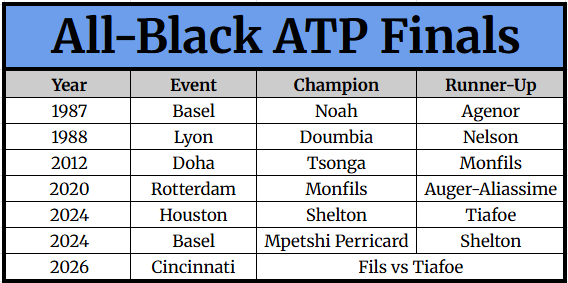
There have been loads of all-Black finals at this level or higher of women’s tennis, of course, including two 1000-level finals just last year (Jasmine Paolini d. Coco Gauff in Rome; Victoria Mboko d. Naomi Osaka in Montreal).
There have been eleven all-Black women’s singles finals at the majors: nine between Venus and Serena Williams, one between Madison Keys and Sloane Stephens, and one between Osaka and Serena. At lower tour levels, Lori McNeil and Zina Garrison played against one another five times in finals from 1986 to 1995.
But in men’s tennis—where the last Black major singles champion was Yannick Noah in 1983 and the last Black major singles finalist was Jo-Wilfried Tsonga in 2008—this is a big deal, particularly coming on the heels of Ben Shelton having won the previous 1000-level event earlier this month in Montreal. It’s a meaningful milestone in a sport where athletes of color remain underrepresented.
But on Tennis Channel on Saturday night, they had a distinct alternate way of talking about this final which I—and others I heard from—found grating while, also, expected.
“This may be our swaggiest final of the year on the ATP Tour,” Brett Haber said after Tiafoe’s win.
Haber reused that language again later in the night, after Coco Gauff had won the final match of the night to book a women’s final against Jessica Pegula, when a graphic showed the Sunday slate.
“Fils and Foe: Could you think of a swaggier men’s final?” Haber said again.
“Swagginess” is in the eye of the beholder, of course. But on Tennis Channel, the concept has nearly become a byword for Blackness. To my ears it’s a lazy trope or code, not unlike how White players so often get called “scrappy” during March Madness. “Swaggy” is theoretically a compliment, but it seems foremost to other and exoticize these players when comparing them to tennis norms.
Or, perhaps, to sound less academic, it’s just corny and cringeworthy. Hearing “swaggy” in 2026 lands in my ears as if someone thought they learned how the kids talk these days from 2010s Justin Bieber lyrics.
Adding Up The Swag
I knew I’d heard this word a lot around Black tennis players on Tennis Channel, and wanted to find a way to quantify its usage somehow. Happily, I found a very cool website, Filmot, that searches auto-generated YouTube captions. Filmot gave me lots of results from the transcripts of Tennis Channel’s YouTube channel. Not everything said on Tennis Channel makes it onto their YouTube, of course, but it was a pretty decent place to start exploring this phenomenon.
The hits—when searching for “swag,” “swaggy,” and other conjugates—were overwhelmingly by anchor Prakash Amritraj, and overwhelmingly addressing the coolness of Black players. I’ve compiled those moments here:
The ending moment is perhaps the most telling: Arthur Fils understands, by this point in his Tennis Channel experience, that when asked Amritraj to list the “swaggiest,” he probably should reel off the names of some Black players. After all, a question about White European players trying out cornrows was introduced as “swag-related.” Are cornrows really “swag-related” or are they just associated with a particular race?
Applying the term to Black players is predominant and disproportionate but not exclusive. But by contrast, there were only three usages Filmot found from Tennis Channel’s YouTube in which “swag” language was used to describe non-Black players: once apiece for Carlos Alcaraz, Novak Djokovic, and Jerry Shang. All three of those times, Amritraj’s word usage was met with immediate laughter.
Because it’s a slang term about coolness, it’s hard to find a great formal definition of “swaggy” that really nails its usage and connotation. Cambridge Dictionary defines it as “having a fashionable and confident appearance or way of behaving.” Other sources emphasize nonchalance in the definition.
After my initial posts about this on social media seemed to resonate, I did hear from a few folks who contended that, while the overall trend was clear, Tiafoe and Fils themselves might just be very authentically swaggy individuals. And that may be true! Swagginess is, of course, subjective.
But the quantifiably outsized usage of it on Tennis Channel to describe Black players makes it clear that something else is going on here. To look at the Tiafoe-Fils pairing and declare it the ne plus ultra of swagginess seems pretty limited.
So I think Tennis Channel should either stop using the word, or start using it way more. Because there are lots of players in tennis, surely, who could check the boxes.
NBA player Nick Young, often called “Swaggy P,” was perhaps most associated with the concept at the height of its 2010s usage, and he had a good handle on it that wasn’t racially coded.
“Swag is confidence: how you dress, how you move, your whole persona,” Young told Sports Illustrated in 2015. “I tell Iggy [Azalea] all the time, ‘You can’t care what people say. You’ve got to have that swag!’”
By that working definition—which I think is pretty good— I’d have lots of new candidates in tennis as the possible swaggiest. Hsieh Su-wei, foremost, of course. I’d also mention Daniil Medvedev, Jelena Ostapenko, Karolina Muchova, Learner Tien, Nikola Bartunkova, Mattia Bellucci—all of them have their own unique forms of swag. I’d love to hear from y’all in the comments as well, about who might be your nominees for this praise.
And of course, anyone who is winning, by definition, gets to seem pretty swaggy in tennis—even if they’re a huge dork at heart.
For a bit more on U.S. Open news—and wild card snubs—read on below the paywall as a Bounces subscriber! -Ben