


NEW YORK — As resale ticket prices have soared and the percentage of attendees with little visible interest in the world-class sport in front of them has also climbed, I’ve heard an existential question repeatedly around the grounds in the last week: what exactly is the U.S. Open right now?
Is it still primarily a tennis tournament? Is it just a backdrop against which to take photos of yourself and your $23 cocktail?
Or is the U.S. Open, foremost and unavoidably, a tennis-themed casino?
The U.S. Open and U.S. Tennis Association seemed to opt for Option C on Monday morning when they announced a new deal with Kalshi, the betting website which has sprinted into all walks of American consciousness this year.
From the U.S.T.A.’s press release:
The USTA and Kalshi today announced a groundbreaking partnership making Kalshi the first Official Prediction Market Partner of the US Open. The exclusive, multi-year agreement begins with the 2026 US Open Singles Main Draw. Through this landmark partnership, Kalshi will have a presence throughout the 2026 US Open across US Open digital platforms and on-court signage.
“We’re relentless about keeping tennis at the cutting edge of global sports innovation and fan connection,” said USTA CEO Craig Tiley. “Partnering with Kalshi gives us an opportunity to pioneer that next generation of fan engagement while ensuring the integrity of our sport.”
The partnership comes amid the rapid growth of prediction market agreements across tennis and professional sports. Kalshi has millions of users, and tennis-related trading volume on the platform is up 25x YoY.
This announcement represents a capitalistic capitulation.
Years ahead of the construction of an actual brick-and-mortar casino across the tracks of the 7 train, the U.S. Open has turned into a lounge for casual and degenerate gamblers alike. Around qualifying last week, spectators—mostly men—could be seen constantly betting on their phones as they stood around matches.
Sometimes they’re quiet and surreptitious; sometimes they’re loud and boisterous. Invested bettors often watch tennis matches the way they might have watched greyhounds at a dog track, screaming for their chosen pick to pay off. But unlike the dogs or horses—or the dice on a craps table, whatever—the players can hear and understand everything being shouted at them. It can be a dehumanizing experience which multiplies the considerable stress of being an elite tennis player. Beyond their time on match courts, players could already feel the effects 24/7 as aggrieved online gamblers pepper vitriol at their social media accounts.
The in-person aspect of this phenomenon is growing rapidly, but it’s not brand new. Last year on Bounces, I wrote about Swiss qualifier Leandro Riedi growing furious at an overt bettor cheering for him courtside at the U.S. Open.

“You can definitely see it immediately,” Riedi told Bounces. “I’ve experienced it enough now. I saw he was already at the first round, and he was screaming my name after the first point. I was like, ‘Wow, that’s a guy who’s betting, for sure.’”
Riedi said that it was as he was getting closer to defeat on Thursday that he became fed up with fickle fandom, and made it clear how much he associates gambling with the angry messages from aggrieved gamblers that fill his direct message inbox after each loss, as happens for nearly all tennis players.
“In the fourth set I was still behind and I was like: if I lose this match he will text me and say how bad I am and wish my mother dies,” Riedi repeated. “So I was, like, no, this guy can’t be here, I don’t want to see that guy. And then he’s pushing me and then if I lose he’s going to text me. That’s why I just said, ‘Can you please go? I don’t need this now.’”
Anecdotally, there’s far more of that going on this year, as many around the grounds have already witnessed.


Kalshi determinedly refers to itself as a “prediction market”—and the U.S.T.A. uses the same term—which sounds more sanitized than “bookmaker” or “betting company.” But during the U.S. Open they’re taking wagers on who will win each match. So, straightforwardly and non-euphemistically, Kalshi is a sports gambling app.
With intermittent glimpses at the Kalshi website as I wrote this on Tuesday afternoon, it became clear how insane the scales of sums at play are here.
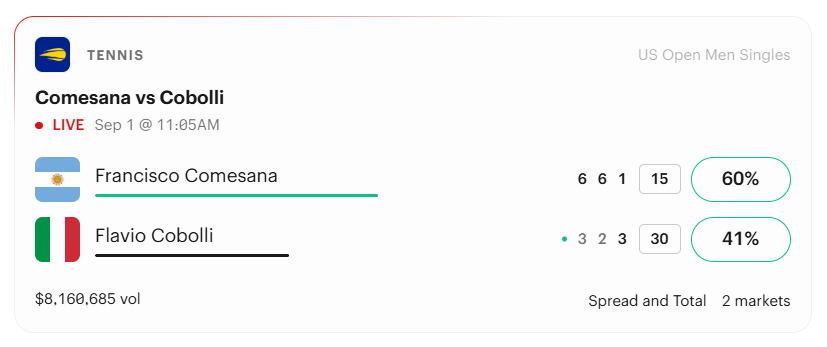
Early in the third set of the first-round match between Flavio Cobolli and Francisco Comesana, the trading volume counter had reached more than $8 million—just on one match on one website. I thought that was crazy.
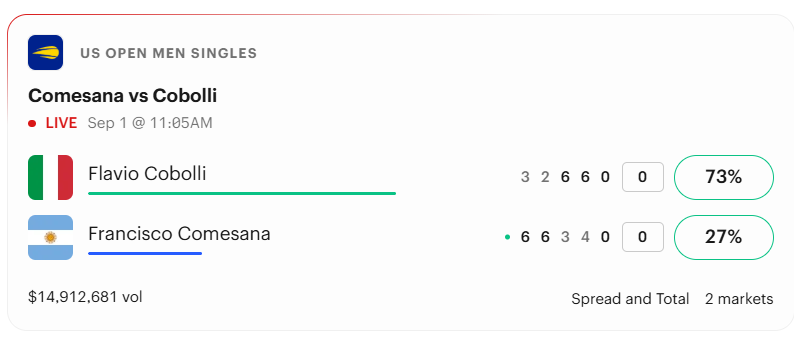
But the cash rush was just getting started. By the end of the fourth set, the betting volume had increased to $14.9 million.
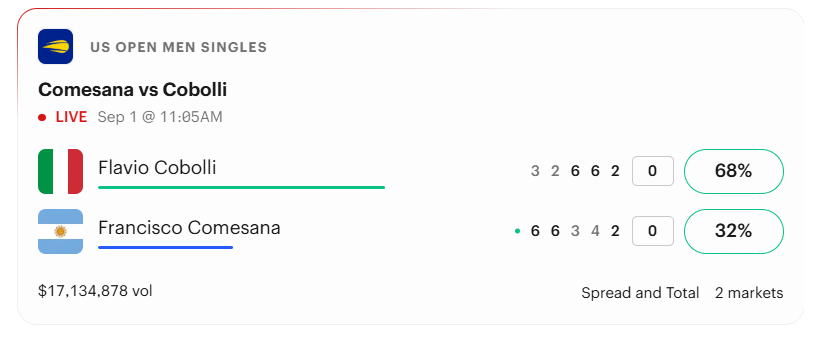
Early in the fifth set, it was over $17.1 million.
By the end, the volume was increasing by hundreds of thousands between each point, topping out at $21.7 million when Cobolli clinched the victory.
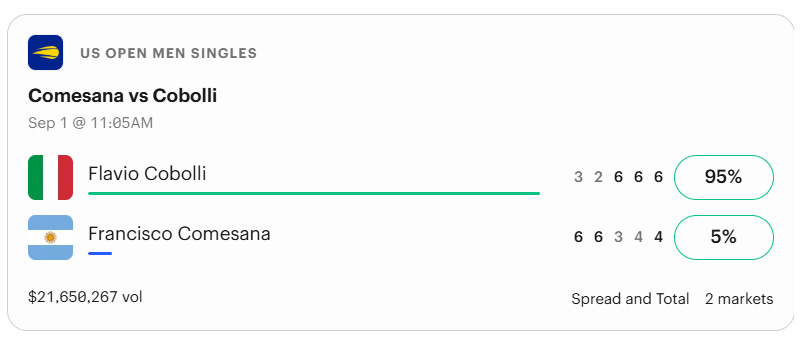
That’s, to be clear, an amount nearly quadruple the record-breaking $5.5 million the U.S. Open’s on-court singles champions will receive along with the U.S. Open trophy.
Also on Tuesday afternoon, a match featuring Taylor Fritz in the illustrious Arthur Ashe Stadium had a trading volume of just under $3 million early in the second set.
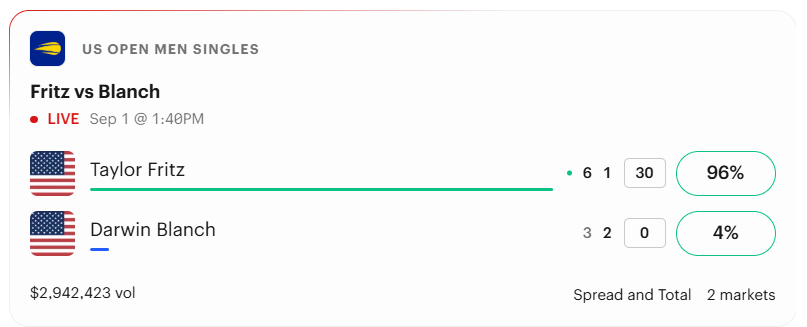
What struck me was how close the betting volume was at far-flung matches between, frankly, nobodies being watched by nobody.
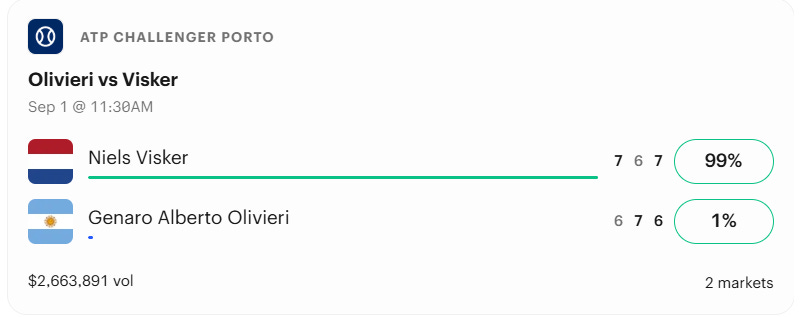
Elsewhere on Tuesday afternoon’s Kalshi tennis offerings, a first-round match at the Porto Challenger between 430th-ranked Niels Visker and 223rd-ranked Genaro Alberto Olivieri had finished with volume not far behind, accumulating $2.7 million on Kalshi.
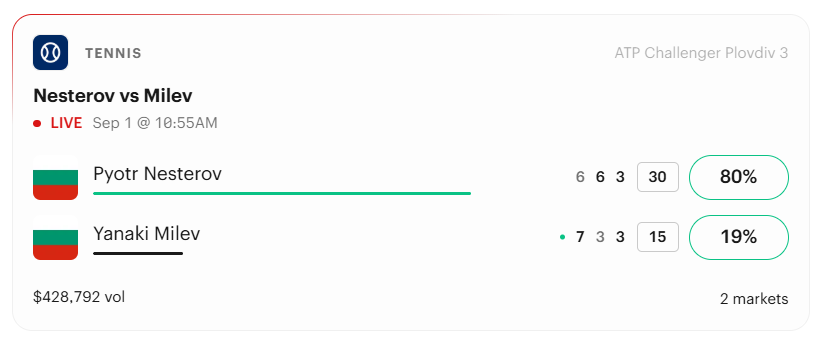
A match at a Challenger in Bulgaria between two even more obscure guys was also getting considerable action. Pyotr Nesterov is ranked 301st and has made just $36,305 in prize money this year. Yanaki Milev is ranked 866th and has made just $13,348. Kalshi had volume approaching a half-million dollars on it when I checked before it had ended. While I have no knowledge that these specific players have been approached by gamblers, you can see, generally speaking, how the incentives and temptations for these types of players to fix matches would be massive.
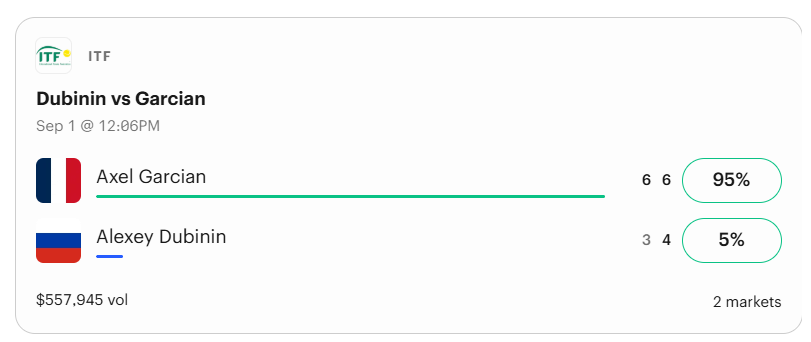
It goes further. Those matches were Challengers, which at least are within touching distance of the main tour. But the live action promoted on Kalshi even went down to the paltry Futures level, where one could bet on a match at the M25+H Bagnères-de-Bigorre event between Axel Garcian, the ATP No. 992 who has earned just $2,761 so far in 2026 and Alexey Dubinin, the ATP No. 2,245 who has earned just $836 in prize money in the first eight months of the year.
These are barely professionals. The winner of this first-round match gets $495 for reaching the second round; the loser goes home with $319; a swing of just $176 at stake.
So why was more than half-a-million dollars bouncing around the outcome of this match on Kalshi?
As I scrolled on Kalshi, the website got even more surreal. Forget about an easily fixable tennis result: with its wide range of non-sports stakes Kalshi has offered infinite insider trading incentives. You may have heard recently about Trump’s teleprompter operator getting caught placing bets on Kalshi about what the president would say in his speeches.
But Kalshi has even created a situation in which a customer could be financially incentivized to bring Ebola to a country. That’s, for lack of a better term, deeply fucked up.
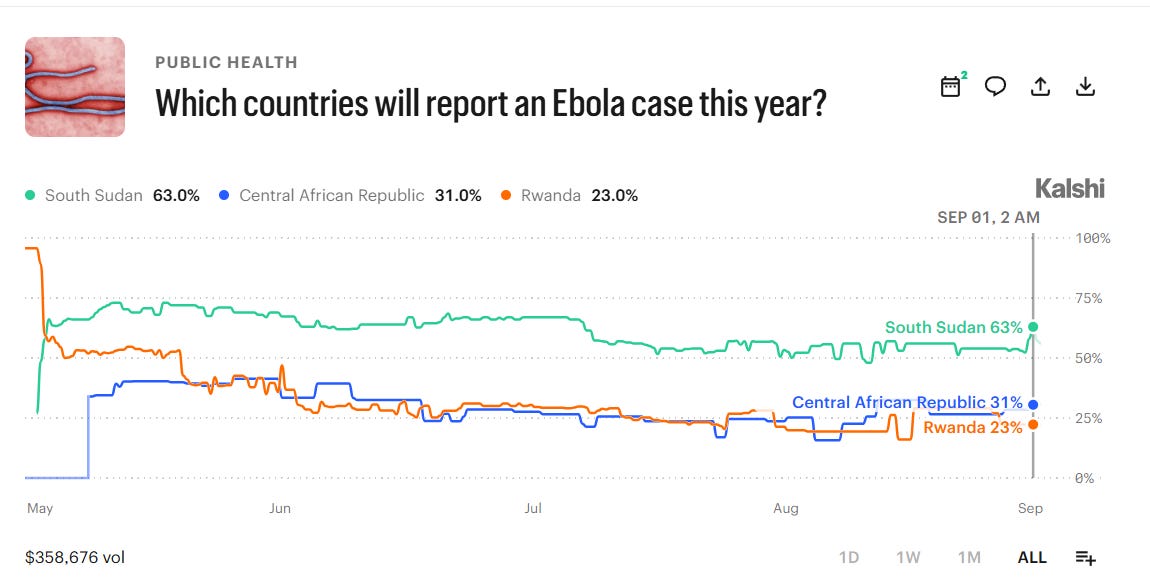
This is a truly bizarre, dare I say dystopian company, and it’s now an official partner of the U.S. Open.
This is not the first time a Grand Slam event—or a tournament run by Craig Tiley, more specifically—has taken an official betting partner. Most recently, in 2016 the Australian Open brought on British bookmaker William Hill as its first official betting sponsor. That year’s tournament, as their luck would have it, was beset by scandals around betting, both after a BBC/BuzzFeed investigation into older stories of corruption dropped on the eve of the tournament, and my own report for The New York Times about suspicious betting patterns in an Australian Open mixed doubles match. (One of the players involved in my report, David Marrero, was later banned by the International Tennis Integrity Agency for two years and seven months for offering to pay for wild cards.)
William Hill’s ads did not return the next year, and the Grand Slam events did not dabble in further betting sponsors for nearly a decade.
But given the enormity of Kalshi’s business, the temptation clearly proved irresistible to the U.S. Open’s better angels this time around. To be sure, betting has gone from a seedy underground adventure to something suffocatingly mainstream in American life. I’m sure I’m not the only one who flipped on the TV and smiled as I saw popular NBA superstar Giannis Antetokounmpo dancing around in a big-budget, pun-based Grease send-up, only to be left frowning when it was revealed as a Kalshi ad at the end.
Tennis players are forbidden by the International Tennis Integrity Agency (ITIA) from doing advertisements for betting companies like the one Antetokounmpo did. Tournaments, however, don’t currently face any such restrictions or regulations on their commercial deals, as you may remember from my report last year on shady Russian bookmaker 1xBet’s involvement in tennis.

The ITIA—which is funded by the U.S.T.A. and other tennis governing bodies—sent Bounces this statement on the U.S. Open’s new deal.
“Betting and trading markets are evolving extremely quickly, and the emergence of prediction and other non-traditional markets bring new opportunities and risk to all sports – including tennis. Whilst commercial deals are outside of our scope, we are working closely with our funders on the identification and the management of the risks.”
What, I wondered, did players at the U.S. Open make of the tournament cozying up to and selling out to a betting company? I asked several players on Monday, hours after the deal had been announced. None of them had heard the news yet; several made indescribable facial expressions when I told them of it.
Danish player Clara Tauson looked the most shocked of all.
“I think it has to be one of the first big tournaments that’s having betting company as a sponsor,” Tauson told Bounces. “But they do whatever they want—and they need the money? I mean, I don’t really have a thought about that right now. I think that’s life: you have to get money from somewhere. I thought the U.S.T.A. had a lot of money, but apparently not enough.”
Chile’s Alejandro Tabilo mentioned the double standard in rules.
“I mean, it’s a little strange because, for us, they don’t allow anything like that,” Tabilo told Bounces. “By that part, it’s just weird. But as long as they give a little bit more to the players after, or stuff like that, maybe that will work. But it still gives a little more incentive to the people to bet, and then they come to our Instagram and they bombard us with hate. So I don’t know; it’s a weird situation for everybody.”
Wimbledon champion Linda Noskova literally shrugged as she explained feeling powerless.
“I know it’s a big topic, obviously: tennis is making a lot of profits thanks to betting and bettors,” Noskova told Bounces on Monday. “But at the same time, they’re not the greatest people that bet on sports, any sport—especially tennis, I would say so. All the bad comments and these negative feedbacks that we are getting after our wins or losses; I don’t know if [because of this deal] there’s going to be a bigger percentage of people writing to us or not. But at the same time, it’s all sport, tennis-connected so I guess it’s good for some people. I don’t think it is the best way to promote tennis, to promote sport. But at the same time, it’s business, so we can’t do much.”
Matteo Berrettini also looked particularly surprised when I told him of the Kalshi deal. Berrettini weighed the positives and negatives of betting in the sport, and as he spoke, the topic brought up many memories for him.
“Actually, my brother [Jacopo] is here: in Roland Garros, he received some messages on his phone threatening my family… They were saying, ‘Matteo is so bad, if you don’t tell him to lose, we’re going to kill your family.’ They were threatening us. Of course, we reported everything to the ATP, and they have the [threatener’s] phone number and everything.”
Berrettini also alluded to Lucrezia Stefanini, the Italian WTA player who was texted a photo of a gun before playing a qualifying match in Indian Wells this March.
“I received a WhatsApp message in which I was threatened over winning yesterday's match,” Stefanini said then. “They threatened me and my family and named my parents, the place where I was born, and they sent me a photo of a gun.”
Berrettini said he didn’t feel unsafe himself, but worried about others.
“We’re 30 years old—we’re big boys and stuff,” he said. “But if I’m thinking about the girls and the younger ones, to receive these kind of messages can be scary. We’re tennis players, you know? So it’s important to protect us.”
There may be ads on Bounces some day, like nearly every publication has, but I can promise that there won’t ever be betting sponsors, even though those are the most common offers in my inbox. I’ve been presented numerous sponsorships from betting companies and have turned them all down. Also, I couldn’t even do it within current tennis rules and keep doing my job the way I have: reporters, historically, can be de-credentialed for having betting sponsors on their websites, and players could get into trouble for doing interviews with a betting-focused outlet. (We are also prohibited from placing our own bets on events where we are credentialed.)
But, undaunted, the tournaments keep raking it in. The house always wins.
In the meantime, I thank you for supporting Bounces and independent, unbought journalism in tennis.
Thank you for reading Bounces! This article is free to read and share, but to support my work here, please consider a subscription, which is 15 percent off during this U.S. Open. —Ben
Fucking grim
Kalshi is by far the worst of the sports betting apps; DraftKings and FanDuel are also pure evil, but they at least work with state regulators and follow state-by-state laws. Kalshi on the other hand is a sportsbook with Trump Jr on its board that ignores state laws on gambling; it has a bunch of awful PR folks constantly pushing its “we’re not a sportsbook, promise!” lie on social media (they have their own creepy mini Kalshi logo next to their Twitter accounts); Kalshi also has a CFTC that under the Trump admin is just a Kalshi cheerleader and never cracks down on it for clearly violating state laws on gambling. Numerous federal judges keep smacking down Kalshi - I believe Kalshi has lost most of the cases that state AGs have brought against it - but it has so many lawmakers in its pocket it doesn’t care (see Rep. Josh Gottheimer, a Dem, posing with Kalshi’s CEO recently on Capitol Hill as Gottheimer praised Kalshi for “taking underage betting seriously” (give me a break). Kalshi is just as loathsome as any of the sportsbooks and what the sportsbooks are doing to the purity of sports, and to tennis in particular, should make us all want to throw up. The players don’t deserve this.
(Edited to add a rant about Gottheimer and the many lawmakers who refuse to treat Kalshi like a sportsbook.)