


MELBOURNE, Australia — If the scoreboard of Rod Laver Arena somehow glitched during Tuesday’s first match—switching from showing the players’ names to showing their Instagram handles instead—it might give the audience watching a better sense of the mission at hand for the underdog.
On one side would be Madison Keys, the defending champion at a major for the first time following her fairytale run here a year ago. Keys’ Instagram handle is @madisonkeys, which is pretty straightforward.
On the other side of the net would be a 25-year-old player playing in her first Grand Slam main draw match. Her name is Oleksandra Oliynykova, and her Instagram handle is @_drones4ua.org_, an announcement of the URL of the website where supporters can send money for her father’s military unit: “the 412th Separate Brigade of Unmanned Systems ‘NEMESIS’, one of the most advanced drone units in the Ukrainian Defence Forces.”
Oliynykova has sought attention for years; her name might be familiar to tennis fans for some of her odder pursuits of funding her once-fledgling career. But once she honed her focus in on a mission for war-torn Ukraine, her tennis flourished. Barely inside the Top 300 a year ago, Oliynykova won three WTA 125 events on clay last fall to climb into the WTA Top 100 and secure a berth in the main draw in Melbourne.
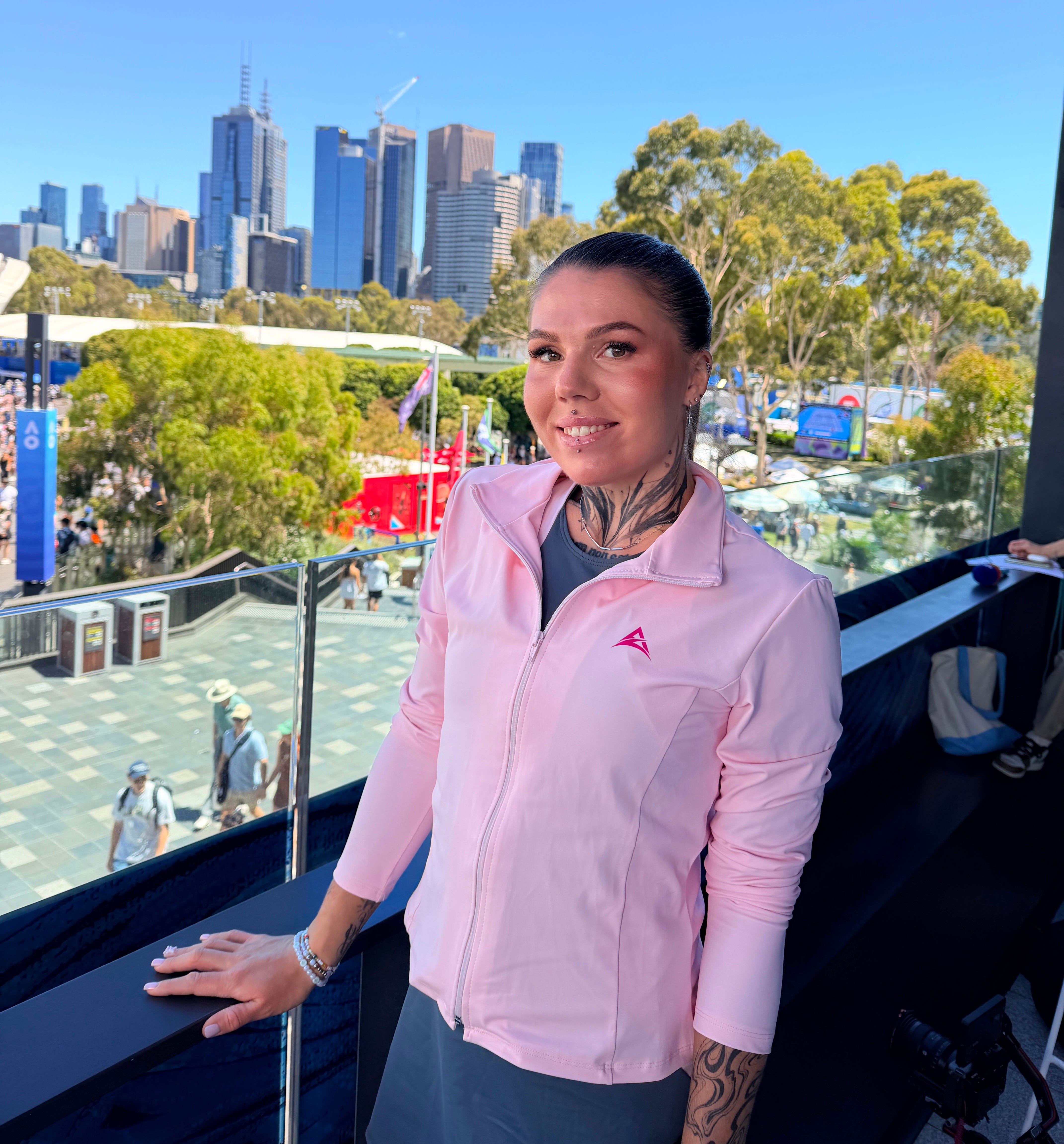
And now that Oliynykova is here, she has a lot to say, and a lot of hope that being on the biggest stage of the Australian Open will get people to listen: about Ukraine and the ongoing wartime conditions in Kyiv, where she still lives and trains; about “dangerous” Russian players who remain in the sport; and about her love of Ukrainian post-punk.
This interview is free for all to read, but please subscribe to Bounces to support my work here during this Australian Open and beyond! -Ben
This interview has been lightly edited for continuity and clarity.
Finding a Purpose, Finding a Path
Ben Rothenberg, Bounces: This is your first time in the main draw of a Grand Slam: how is this whole experience for you so far?
Oleksandra Oliynykova: It’s special, and here in Australia it’s really nice. Yeah, so many new emotions and I’m just excited.
I practiced for the first time on such a big court; the day before yesterday I practiced on Rod Laver Arena. And for maybe the first two minutes on court, if someone would’ve asked me what my name is, I would not be able to answer because of the emotions and impressions. Yeah, it’s a really amazing feeling.
Ben Rothenberg, Bounces: You’ve been playing pro for a while, and I’ve been reading about you for a while, but you sort of snuck up on me here. I was looking at the entry lists for this tournament, and I was like, ‘Oh my gosh, she’s here. I didn’t realize that you were rising so fast [Ed. Oliynykova, now 90th, was ranked 286th a year ago].
What do you think was the key to having such a great year last year, being able to move really quickly up the rankings into the Top 100?
Oleksandra Oliynykova: For me, now I feel very motivated to play. Before, I don’t think I had enough confidence; actually, I’m not confident in myself still.
But the thing is that, my father volunteered to go to the army in the summer of 2024. And I’ve gotten this feeling that I should be here, at the biggest tournaments, to speak my story—because I know that I can help a lot. I can help my country by sharing my story, because it’s the same situation which so many girls like me in Ukraine [have]: they are also waiting for their fathers or husbands or brothers who are inthe army. I told myself that I need to be here to tell this.
And, yeah, I started to work. I was working before on 100 percent; now I’m working on 300 percent. And also when I go on these big courts at bigger tournaments, I’m not anymore thinking, ‘Oh, how can I win this? Why am I here? I’m not that good!’
Now, I don’t care. Maybe I’m not the best player; maybe I’m not the most experienced or powerful. But I know that the things which are motivating me are probably the most powerful on tour. So that’s how I made it.
Ben Rothenberg, Bounces: It seems like you have a very clear sense of purpose.
Oleksandra Oliynykova: Now I’m completely clear. I know why I’m here. I know what I want to share. And for me, it’s also important to help, I have a lot of projects I’m sharing on my social media where I’m trying to help soldiers in my father’s unit.
So yeah for me, it’s important. It is something I’m putting above all.
Leaving Ukraine, Returning to Ukraine, Living in Ukraine
Ben Rothenberg, Bounces: When I first read about you, I think you were describing yourself as a refugee from Ukraine. Though you left Ukraine before the war started, right?
Oleksandra Oliynykova: Yes, I left Ukraine in 2011, and it was because my father was protesting against a pro-Russian president [Viktor Yanukovych].
We could come back after the Revolution of Dignity, when the revolution for freedom and democracy won. But we lost everything in 2011. So that’s why my family stayed in Croatia for a longer time.
But now, I came back to Ukraine. So right now I’m practicing in Ukraine. I came to Australia from Ukraine and after Australia I’ll go back to Ukraine. So yeah, I actually live in Ukraine right now.
Ben Rothenberg, Bounces: And that’s rare, right? There’s not that many of the Ukrainian players who are in Ukraine often right now, as far as I know.
Oleksandra Oliynykova: [Among other] professional players, no one else is living and practicing in Ukraine. They are coming to Ukraine, but they are doing their preseasons outside of Ukraine and are based outside of Ukraine, so I am the only one.
Ben Rothenberg, Bounces: How does it work having a career base in Kyiv while the war is still continuing? There’s still bombings sometimes, there’s still things going on in the war.
Oleksandra Oliynykova: Yeah, there is bombing. Actually, the day before I started my trip to Australia it was a massive attack on Kyiv and my apartment was shaking because of an explosion somewhere really near my home. In the morning I checked, and it was the house across the road that was hit by a Shahed drone.
Yeah, in Kyiv there are a lot of attacks, especially with the Shahed drones, and that’s why it’s very important to help the Ukrainian army with these anti-Shahed drone systems. Because it’s something that the regular Ukrainians experience…[sighs]…a lot. Really, a lot.
You know, now we have problems with electricity. And in my apartment, when there is no electricity, there is no heat and no water. On the tennis court, I practice in a very nice club. There is a very good team of really great professionals. And there, we have a generator, so there is the electricity and water. It’s autonomous; it’s not connected to the [grid]. But in my apartment, there are some times when we have no electricity for like 15 hours. And yeah, it’s tough, but you get used to it.
But for me, the important part is that my main motivation is not really about tennis. I love playing tennis, but, you know, I always say that I don’t need a big arena to enjoy my game; I can play on any court and I will love it absolutely the same. But I need a big arena to represent my country, to represent Ukrainians, and to tell people that the war is still going on and we need their support and their help.
The Mission in Melbourne
Ben Rothenberg, Bounces: Well then, you got the biggest stage possible in this draw. You could have drawn anybody, and you got defending champion who you are getting to play on Laver. Obviously it’s a big match whenever the defending champion comes back for her first match, always a big occasion. And now you get to be there, too.
When people watch you and they watch this match, what are you hoping that they know about you, and the story that you want to tell about yourself and about Ukraine?
Oleksandra Oliynykova: Yes, yes, that’s actually what I want to share: I hope, because of playing on this court with so many people watching, that they will check and find out something more about me and about the things I’m doing outside of the court.
And yeah, I’m really excited. I have very positive expectation, and I think it’s a great experience to play against a player like Madison.
And yeah, it’s actually my first Grand Slam main draw, first time in Australia ever—because I didn’t play in juniors here. And now I’m playing my first match against the defending champion—it’s like a plot for a movie. So in some way I feel like a winner already, because I think you need to have so, so much luck to get an experience like this for your first Australian Open. You need to be really lucky, and I’m very happy about it.
Ben Rothenberg, Bounces: And lots of people never get the chance. Even if they play here five times, they might never get to play on Rod Laver Arena sometimes. So you were lucky, but it’s exciting because I know you want the stage, you want the spotlight and the attention.
Oleksandra Oliynykova: Yeah, but not for myself. Actually, I’m shy by my character, and I think I’m more introverted as a person. But I just have some beliefs, and that’s why I need this attention. It’s important for me.
Ben Rothenberg, Bounces: One of the other things I read about you a few years ago is how you were doing different things for funding. You had an NFT, like a tattoo on your arm or something like that? And a crypto?
Oleksandra Oliynykova: Yeah, but it was so many years ago…
We made this NFT, and now, I mean, it’s kind of done, this story. I think it was like five or six years ago.
Ben Rothenberg, Bounces: But is it still a tattoo, that you still have?
Oleksandra Oliynykova: There is not any tattoo.
Ben Rothenberg, Bounces: It wasn’t a tattoo? I guess I don’t really understand NFTs at all, so I wasn’t clear on that.
Leveling up the Army and Herself
Ben Rothenberg, Bounces: In terms of your tennis, when you’ve been playing much better this past year, what has been better about your game? What have you felt better in with your shots? Or is it all just more about motivation and focus?
Oleksandra Oliynykova: I think it’s based on the mental part. The things I improved in my game, it’s also 100 percent because of the mentality. Because when you get this motivation and you start to work, it’s easy for you to sort out what your priority is. And then some other things which maybe can disturb your attention because you feel emotional about them, you can put them in the background and work on what is important.
Yeah, it’s probably the mental things. I was trying to improve on court the way I think during the matches. My mental stability during the match, I improved it so much. But it’s also because of these priorities that I’ve gotten more consistency.
Probably my game became better, but I don’t think it was that much because of working on something like ‘OK, today I will improve serve or forehand,’ because I was not doing anything about improving something specifically. I just think it is completely based on mentality, and the things I improved in my tennis were a general improvement. When you are focused 100 percent on what you are doing, you know what you want to get out of your work.
Ben Rothenberg, Bounces: Prize money at Grand Slams now has gotten huge: it’s been growing and growing and growing the last few years. What does it mean for you, just in terms of your career, in terms of what you want to be able to do to help people in Ukraine, to be in this level of top 100 where you’re going to be getting whatever prize money you get here, plus hopefully being able to enter the rest of the big tournaments for the rest of 2026? What can that do for yourself and your career?
Oleksandra Oliynykova: For me, ooh, it’s an interesting question. Because I’m here with no coach, and I travel alone. Even with all this huge money, I don’t feel good just to spend it. Because I’m in the situation that I’m a person who is living in Ukraine, and I have so many friends who are in the army, and my father, he’s a soldier.
And always, when you don’t know what’s going to happen tomorrow, you don’t feel OK with just spending money and traveling with a big team. Yeah, I will probably continue to travel alone, and I will use this opportunity—also this financial opportunity—to help Ukrainian soldiers.
Ben Rothenberg, Bounces: To help them buy weapons and things like that.
Oleksandra Oliynykova: Um, I cannot buy a weapon (laughs), because, like, I...
Ben Rothenberg, Bounces: You can give them money, I guess?
Oleksandra Oliynykova: I’m not in the army, and I don’t have this power to buy weapons. If I can be honest: I would love to, because that’s what we need in Ukraine. We need to defend ourselves, but I have no power to do it. But there are a lot of things—not just weapons—which we need for protection and for normal function of the military, so soldiers can have normal human facilities—that’s also very important.
And yeah, and for myself, [the money] is probably just giving some feeling of stability, because I was building my career with very, very small financial resources, with no sponsorship. Of course, now I can be chill about, like, airplane tickets, traveling, that I will have a normal apartment.
I can have normal dinner. Because I remember when I was playing 35ks, I was having just some sandwiches for dinner, because I couldn’t spend money to go to eat something. I had like a really, really low budget when I was just starting.
I can feel normal about those things, but I am not spending a lot on myself. Probably not too many things are going to change for me; it just maybe will mean that I shouldn’t be worried anymore about if I will have enough money for a ticket to go to the next tournament.
Coexisting with Russians on the Tennis Tour
Ben Rothenberg, Bounces: Obviously, since the war started, in the WTA there have been both Ukrainian players and Russian players who are still on tour together.
How is that dynamic for you, as someone who’s living in Ukraine during this war, of sharing space and maybe sometimes having opponents in matches from Russia?
Oleksandra Oliynykova: I’m absolutely not OK with this decision, because I strongly believe these players should be disqualified like in other sports. I think it’s very sad that people are losing attention because this is a long war; of course they are not doing research.
When they see here a [Russian] player, they see just—if we will talk about WTA players—girls playing tennis. And it all looks fun: nice dresses, they’re filming some TikToks, making posts on Instagram, and they look like normal girls. And people don’t feel like these people are dangerous. But actually, if you research, you will find that many of them are supporting Putin or Lukashenko—and this is something which is super easy to find.
And I was trying to speak about this a lot; maybe now when I will get more attention, maybe people will hear it. Because many of them are not the people that they’re showing on the TV or on the tennis courts. Because behind it, there are some really horrible things, and it’s not OK that people are ignoring this.
Because their opinions, and the things they are doing, they are dangerous. These players are one of the reasons why my apartment was shaking before I came here. And now I’m here and I see, like, the same kind of treatment for me and for them. I mean, they paid for the Shahed drones. They supported the fact that their army is doing this—and it’s not OK. And now we are absolutely not in the same condition, and this is their mistake as well.
Alternative Look, Alternative Sounds
Ben Rothenberg, Bounces: On a slightly happier topic, I was looking at photos of you, and now I see you’ve changed some of the tattoos, and obviously you’ve done the piercings and stuff too, which is not normally what we see in tennis players. How would you describe your type of personal style?
Oleksandra Oliynykova: Yeah, I mean, I like this kind of alternative style. I like piercings, I like tattoos.
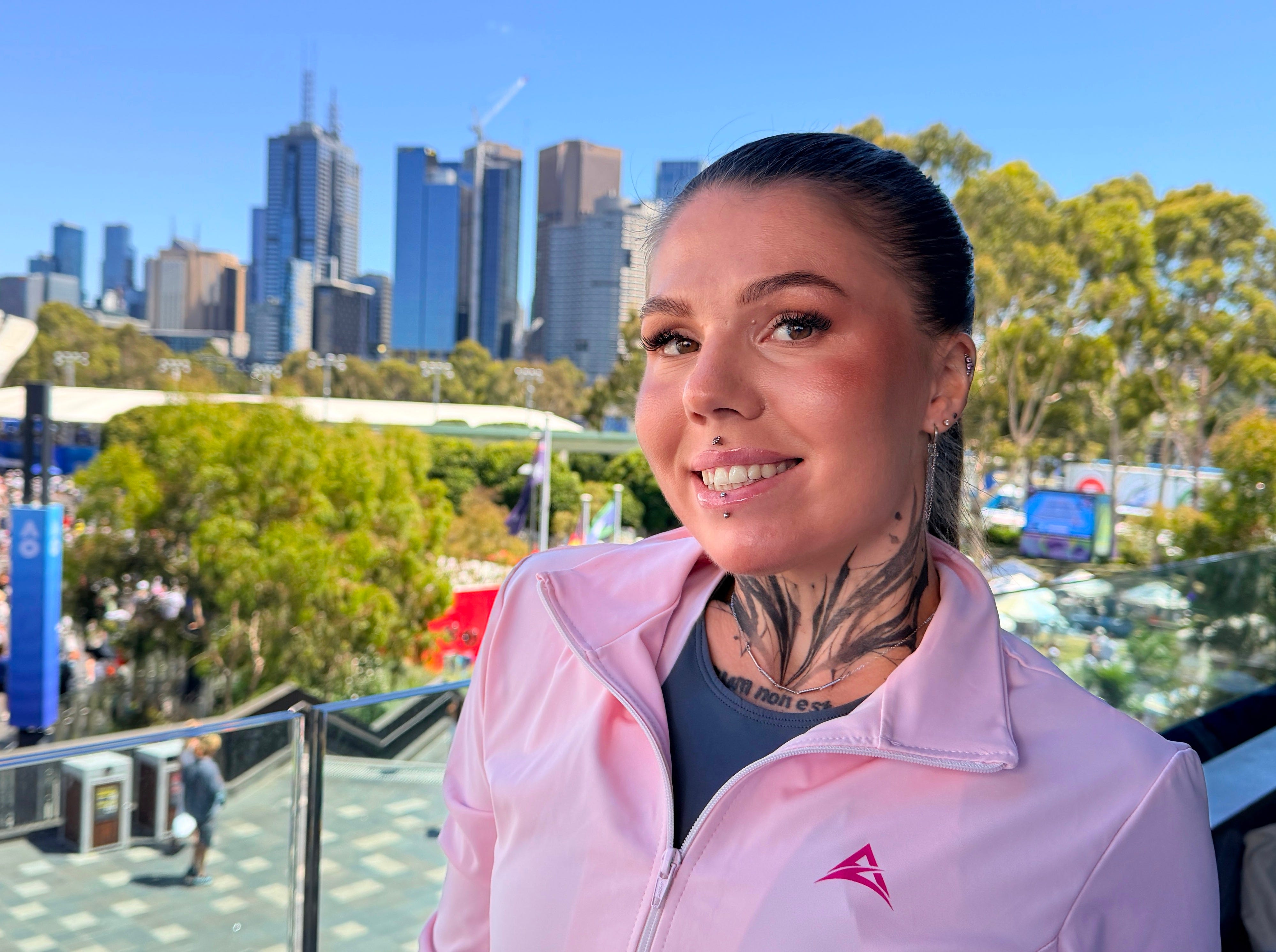
I think it’s actually very connected to my music preference, because I started to listen to rock music when I was like 11 or 12.
Ben Rothenberg, Bounces: What kind of rock? Who do you like?
Oleksandra Oliynykova: It’s been changing during my life. Right now, my favorite music is post-punk—especially Ukrainian post-punk. Actually we have so much cool stuff in Ukraine, so much very good music. So yeah, I hope the people who will read the interview, they will research it, because really, there are so many things I can suggest.
Ben Rothenberg, Bounces: I can embed a clip of a song, if you have a favorite song?
Oleksandra Oliynykova: Probably any song of DK Energetyk, the band I was at the concert of in Kyiv during my pre-season—it was super fun.
And yeah, and I remember when I was a teenager, I was dyeing my hair different colors. I made my first tattoo when I was 16. Yeah, because of my music preferences, I started also checking out all this alternative style, a lot of tattoos, some extreme hair colors. Now it’s just a part of me and yeah [laughs], that’s how I have this style.
Below the paywall for Bounces subscribers, a look at Matches to Watch on Day 3 of the Australian Open. Thanks for reading and supporting Bounces! -Ben