


MELBOURNE, Australia — For the second year in a row near the midpoint of the Australian Open, Jannik Sinner looked cooked.
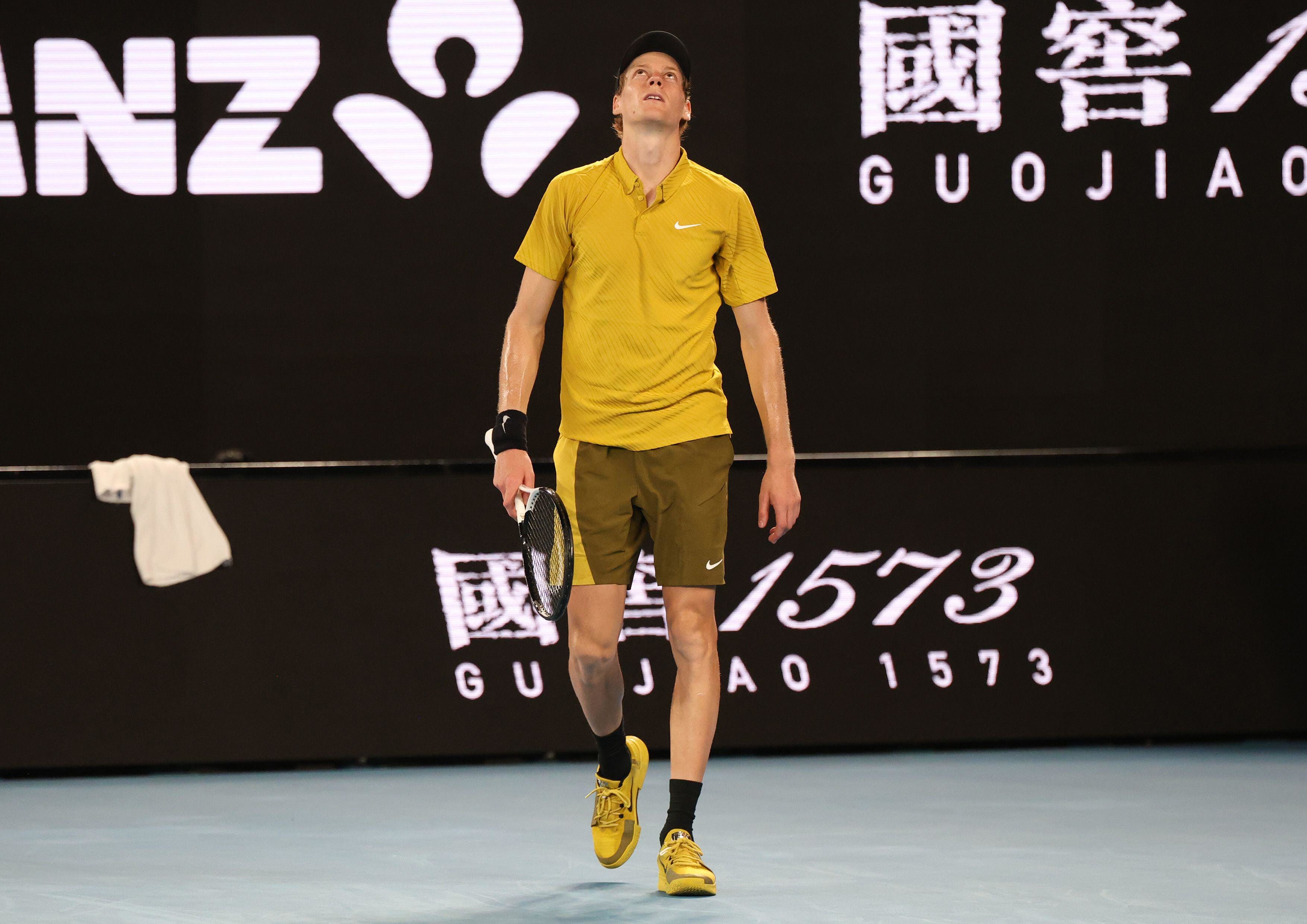
With temperatures nearing 100°F (38°C) in Melbourne, the two-time defending champion was withering in the searing Saturday afternoon heat against 85th-ranked Eliot Spizzirri.
After the pair had split the first two sets, Sinner was serving at 1-2 when his limbs began to wilt, one by one. He cramped in his right hand, and then his left arm. He pulled at one leg and then the other, hoping to snap some life back into each extremity. But his movements only grew more and more lumbering and labored: Sinner was “moving like an arthritic stork,” as Eleanor Crooks of the Press Association aptly described it.
At deuce, Sinner lost a long rally and limped over to the corner where his coaches were sitting. After an initial consultation in Italian, Sinner stumbled back to the corner for a second visit. His second detour caused chair umpire Fergus Murphy to call a time violation on Sinner, but Sinner needed more help from his team, and this time addressed his coach Darren Cahill in English.
“I don’t know what to do,” Sinner told him.
“We just have to get through to the end of the third set, mate,” Cahill replied. “Even if you walk around, don’t worry. We take the break.”
Cahill was referring to a break that would come after the third set due to the heat rules in effect. In the less-urgent, longform format of best-of-five, intentionally allowing a set is a viable strategy.
After shaking out his legs to fight off increasingly visible cramps, Sinner armed in his serve, and then listlessly lost a rally as Spizzirri hit an uncontested drop shot winner to the forecourt to claim the break and a 3-1 lead in the third set.
Sinner retreated once more to his corner, where his team again told him to take it easy, at least for a while.
“Non correre,” his coach Simone Vagnozzi told him, meaning: “Don’t run.”
“Just walk,” Darren Cahill echoed in English.
But as just Sinner’s time remaining in this tournament looked to be counting down, another meter had been ticking upward:
The Australian Open Heat Stress Scale had been inching decimal by decimal; just before Sinner was broken, the meter had hit the 5.0 score needed to trigger a suspension of all outdoor play at the tournament.
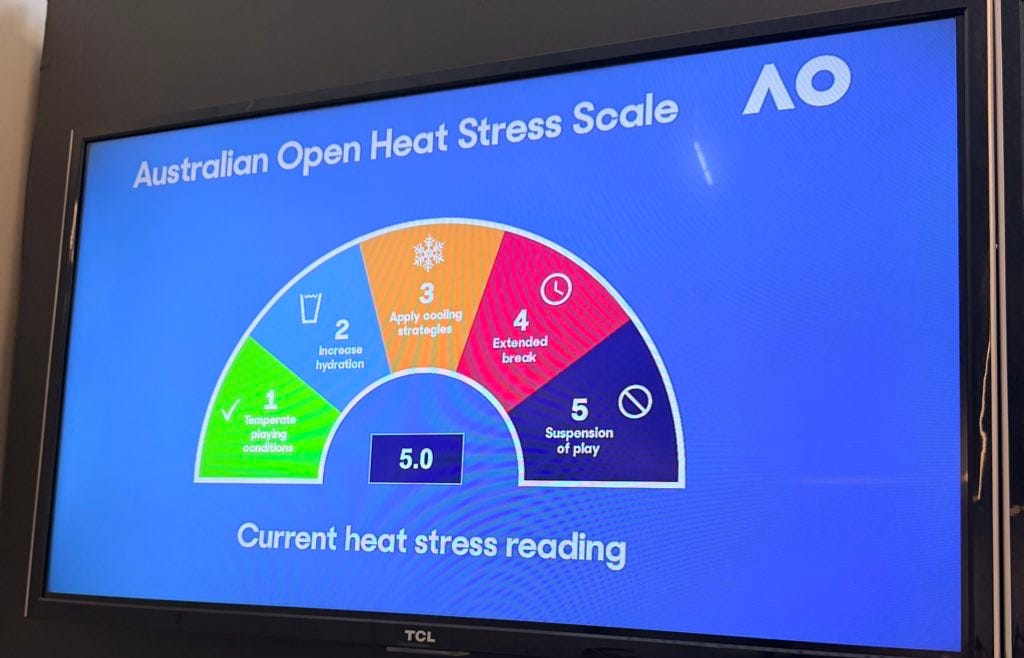
Before Spizzirri could begin serving up 3-1 in the third, Murphy ushered both players toward his chair.
“I got a message from the tournament office: Now, because of the heat, we’re going to stop,” Murphy told the players. “Nothing to do with anything else; just because of the heat.”
Sinner eagerly left the court as soon as he could to scurry into the air conditioning as the roof closed; Spizzirri sat on his chair, smiling and shaking his head.
The match, as expected, turned in Sinner’s favor from there. Though he still looked depleted, Sinner was no longer rapidly diminishing under a closed roof, and rallied for a 4-6, 6-3, 6-4, 6-4 victory.
“I struggled physically a bit today; we saw this,” Sinner said in his on-court interview. “I got lucky with the heat rule. I know they closed the roof, and I took my time. And as the time passed, I felt better and better.”
In his post-match press conference, Sinner again emphasized his good fortune at having the match pause when it did.
“Yeah, got lucky today,” he said. “At the point when they closed the roof—it takes a little bit of time—I tried to loosen up a little bit. It helped.”
This was the second straight year in Melbourne that Sinner had escaped an afternoon air fryer on Rod Laver Arena, having won in four sets against Holger Rune in the fourth round a year ago. It might seem “lucky” to narrowly escape defeat that looks certain, but it’s also unlucky to be a superior player who gets the misfortune of being scheduled in the hottest moment of the tournament.
And then there are other forms of luck and lotteries, geographic and genetic.
“This heat's nothing compared to what we deal with in Florida,” Spizzirri said after the match, echoing an annual refrain from Americans when they’re asked about warm weather anywhere. So often in Melbourne, it seems, winners and losers are simply determined by which player has a base in Boca.
And then there’s the genetic factors of dealing with heat, including the pair of recessive MC1R genes which combined to make Sinner a redhead. Redheads lack eumelanin to protect their skin from UV rays, and also are more sensitive to thermal discomfort (while having a higher tolerance for pain generally).
As possibly the only other ginger in the room—and someone who once combined my #TennisNeedsGingers campaign with an additional #GingersNeedNightSessions rallying cry—I wondered how much Sinner had come to accept that our kind just isn’t necessarily built to thrive in the peak of Australian summer.
Sinner smiled as he answered.
Ben Rothenberg, Bounces: Jannik, I’m just curious as someone else who is also a redhead with pale skin who struggles in the heat: I’m wondering if you think this is something that’s just always going to be tough for you, on some level—genetically? Or if it’s something you can catch up to other people on? Or is it just the hand you were dealt in life?
Jannik Sinner: No, I mean—we don’t know. I mean, for sure, as I said before the tournament: physically, I feel good. Mentally, also. The only thing, at times, you can do is to fight.
Let’s see. I mean, for sure it’s an area where I would love to improve, and there is a reason why I go to the gym every day: I’m trying to get better.
But in the same time, you know, every player has his own small problems. And maybe this is mine? You don’t know. But, for sure, there is room to improve. I’m quite sure we will do everything possible to improve in a positive way. Then we see how it goes.
But is any of this luck, good or bad? As Sinner extended his life in this tournament, perhaps because of some of my own delirium in the heat, I flashed back to a near-death experience of my own from nearly two decades ago.
On July 4th, 2006, a friend picked me up at my house to go to an Independence Day barbecue at another friend’s house. As we began the short drive, it started raining heavily. Within just two blocks of my house, the storm intensified further, and a large tree fell onto the roof of the moving car. The car was totaled, but we both survived with minor injuries (he had a dislocated shoulder; I needed a few stitches to close up my bloodied scalp). It was fortunate, for sure, that we were in his Volvo rather than the soft-top convertible I was driving in those days.
A common question came up in conversations with family and friends in the hours and days after: had we been “lucky”? Well, we were lucky not to be killed, sure. But we were also, undeniably, profoundly unlucky to have been in a moving car which was underneath this tree in the exact wrong second when it fell onto the road.
I may have spent too long in the heat today myself to think this analogy makes sense; after all, hot weather in Australia is a far more probable occurrence than a falling tree landing on you.
But still, Sinner was unlucky to have to play against a Florida-based opponent in the hottest hour of the tournament so far, scheduled in the second match of the day session. He was unlucky, too, that Karolina Pliskova didn’t put up much resistance against Madison Keys in the first match; she could have shortened the amount of time that would have elapsed in his match before the heat rule kicked in.
But he was fortunate, perhaps, that the tournament’s heat stress scale mirrored his own distress, both ready to call off the fight at the same time. And it’s also fortuitous that the forecast for the rest of the days on which Sinner could play this year in Melbourne look considerably more moderate. With this wobble behind him, I think this tournament should once more be his to lose.
There was one more moment in which a star’s tournament flashed before his eyes on Saturday, this one entirely of his own doing:
Not heeding any lessons from the moment of carelessness that got him defaulted from the 2020 U.S. Open, Novak Djokovic angrily smacked a ball during his otherwise unremarkable third round win over Botic van de Zandschulp, launching it on a trajectory which came worryingly near a ballgirl’s head.
Djokovic, who has previously downplayed the severity of various other reckless moments of near-disqualification in his career—of which there have been a shockingly high amount—answered directly and succinctly, and considered himself “lucky.”
“Yeah, I apologize for that; that was not necessary and in the heat of the moment,” Djokovic said in his press conference. “Yeah, I was lucky there, and I'm sorry for causing any distress to the ball kid or anybody.”
For more on Round 3 at the Australian Open, and how it sets up a really loaded second week, check out the latest episode of No Challenges Remaining with myself and Tumaini Carayol:
For more on the fourth round matches ahead, head below the paywall for a look at some of the great Day 8 matches on tap for Sunday. It really should be an absolute smorgasbord of delicious stuff. Thanks for reading Bounces! -Ben