


Four days before the first balls are to be struck on the first day of qualifying matches in singles and mixed doubles, the U.S. Open had itself a banner day of good news rolling in.
The biggest headline, as far as the competitive outlook for the Open is concerned, was something outside of the tournament’s control: defending champion Carlos Alcaraz announced and confirmed his participation. It will be the seven-time major champion’s first time competing since withdrawing from ATP 500 Barcelona back in April with a wrist injury that proved persistent.

Alcaraz, who spent months in a brace, has been training at full strength lately, including recent sessions on Spanish hard courts with Holger Rune, whose own injury comeback will be coming slightly later.

According to Murcian reporter German R. Abril, Alcaraz’s training session today lasted four hours, starting with practice sets with Rune.


Can Alcaraz win the tournament? In this men’s tennis economy, why not? Jannik Sinner’s status remains hazy, and the rest of the field hardly seems robust or reliable. Of the eight men’s quarterfinalists in ATP-WTA 1000 Cincinnati this week, only one of them has won a Masters 1000 title before (Taylor Fritz, who won Indian Wells four years ago). Alcaraz reached the final of the last four Grand Slam events he played, winning three of them. I don’t think he has to be at 100 percent to be in the hunt for the title in New York; at 24-3 (88.9 percent), Alcaraz narrowly holds the best U.S. Open match-winning percentage of all men in the Open Era.
Alcaraz will also have a chance to warm up before being thrown right into singles: Bounces can report—and it’s been something of an open secret—that Alcaraz has been planning for months now to play mixed doubles in New York with Serena Williams. With both now healthy and ready to post up, expect them to be the marquee team of next week’s event. Serena won her lone U.S. Open mixed doubles title about five years before Alcaraz was born, taking the 1998 U.S. Open with Max Mirnyi. Serena did look rusty in Cincinnati this week—Venus was definitely the stronger player in their pair for most of that match—but Alcaraz, who will happily run down everything, is a perfect partner for her.
One of the biggest question marks for Alcaraz in New York: what will his hair look like? It’s longer than ever now, and he’s never before worn any sort of headwear on court during his professional career. Will Victor Barber cut it into a signature fade before he comes to the U.S.? Will his brother’s blessed hands shave it off again in a Manhattan hotel room like last year?
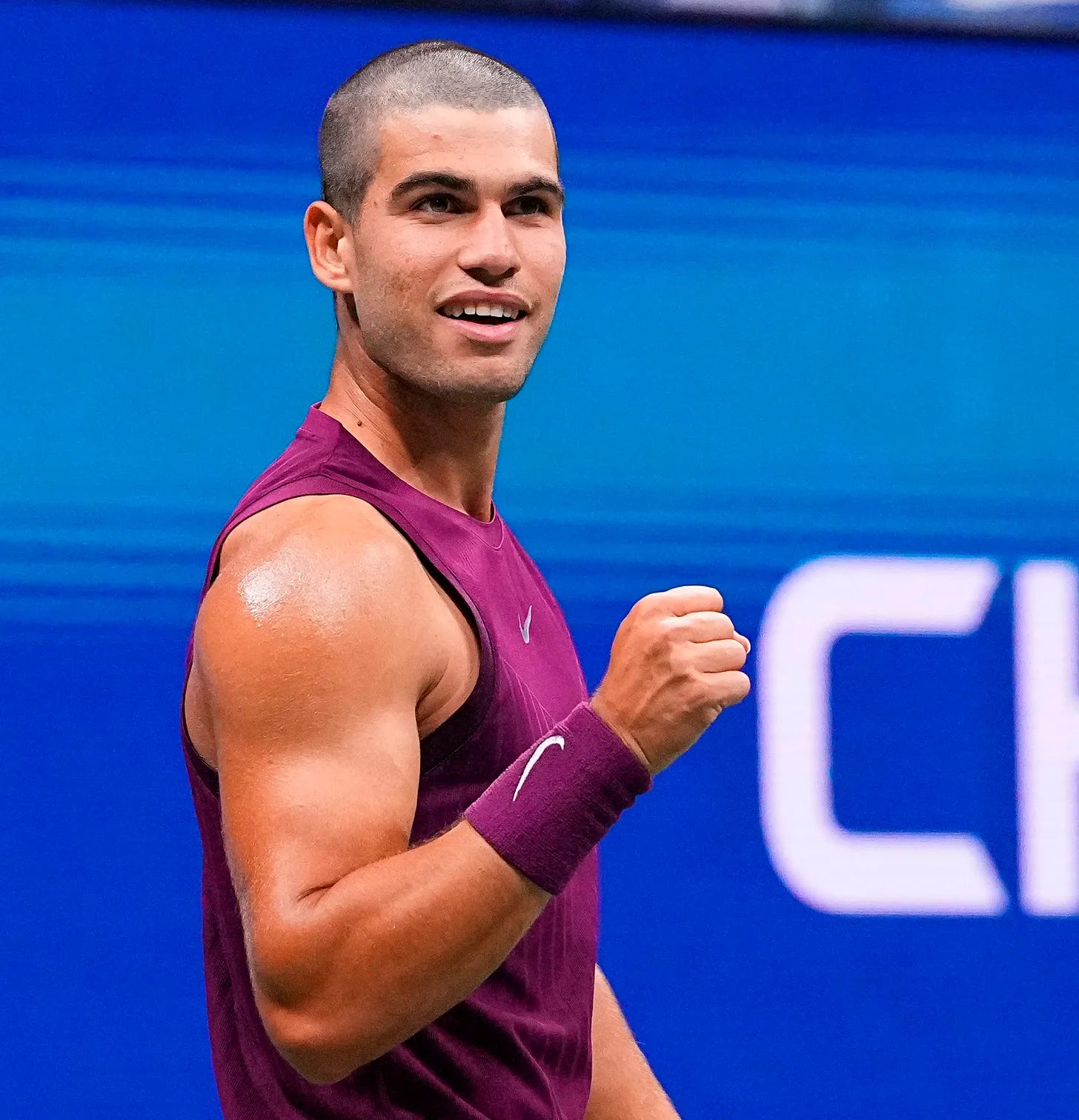
Or will his mane be in full flow even before his game might be? Maybe he’ll get a better set of cornrows after landing in New York? The possibilities are endless.
The U.S. Open has known an Alcaraz arrival was still possible, but its bigger planned announcements on Thursday were a one-two punch of player-friendly concessions to quiet the player discontent that has been a running topic of the majors.
The headline of the press release: “US Open Offers Largest Player Compensation Package in Professional Tennis History at $108 Million, an Increase of 20 Percent from 2025.”
The U.S. Open, which also set a record with last year’s purse of $90 million, had already been dominating the other majors on prize money fronts.
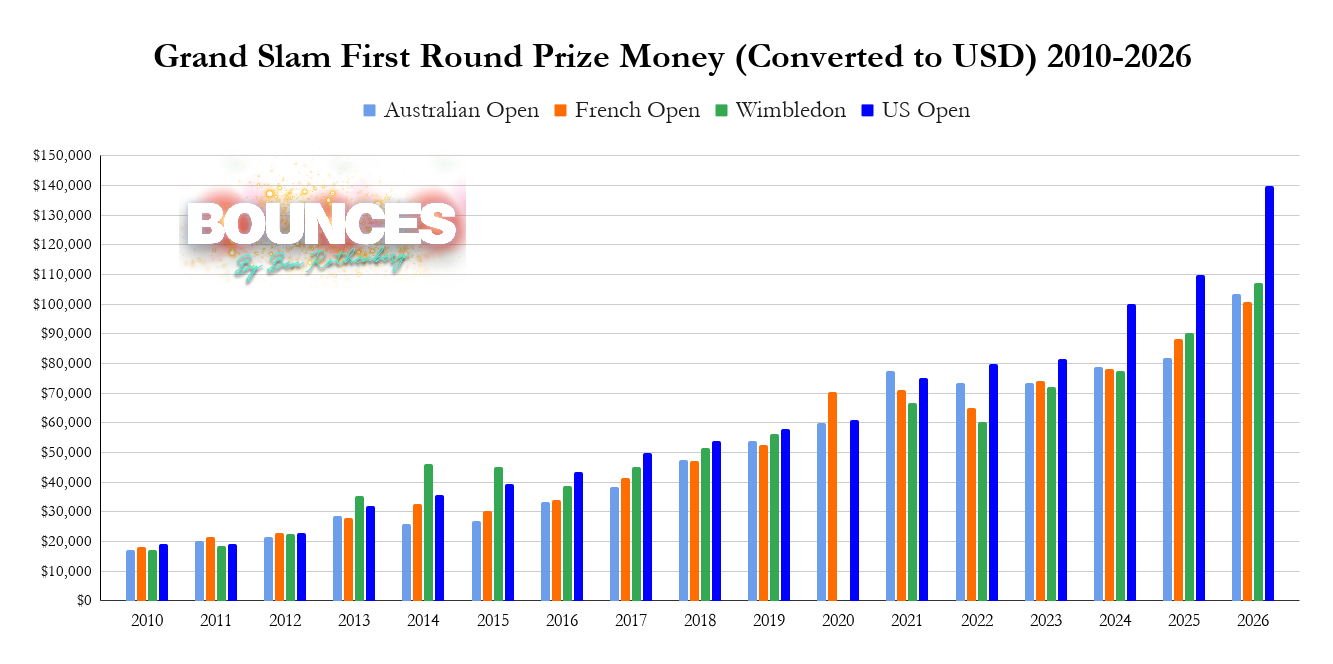
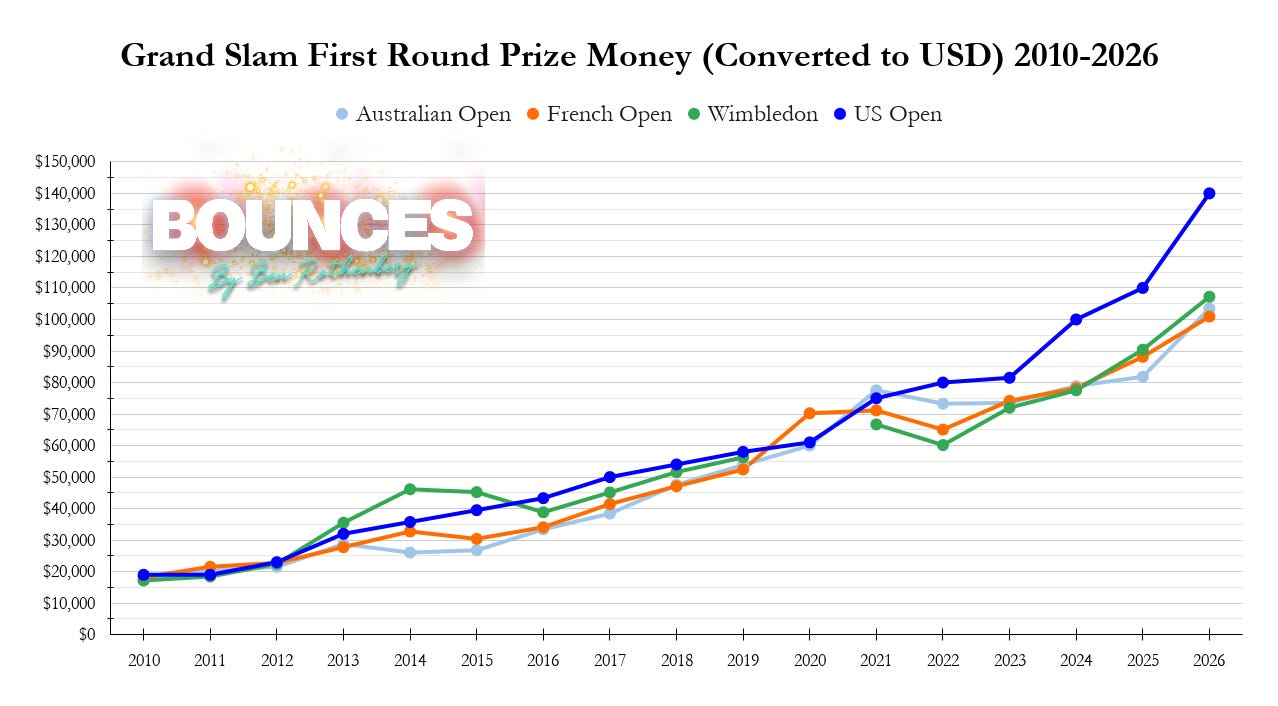
I made graphs that track first-round prize money since 2010, converting all currencies to U.S. Dollars (using what their exchange rates were at the time during each tournament). None of this year’s offerings at the first three majors of the year matched the $110,000 that the U.S. Open paid for first-round participation last year; the U.S. Open then truly left the pack in its dust with Thursday’s announcement that first-round losers would be paid $140,000.
The second part of the package announced on Thursday was a “seed” investment into a “Player Support Program,” including pensions, which have previously been the sole purview of the ATP and WTA.
From the press release:
The four Grand Slams are aligned on the importance of supporting players throughout and after their playing careers. The US Open will become the first Grand Slam to establish a Player Support Program. As part of the total 2026 compensation, the US Open committed an initial $2 million, equally split between men and women players, which will be held in an escrow account pending the finalization of details of the new program, with guidance and input from the newly formed Grand Slam Player Council. Designed to complement existing end-of-career pension funds, this new US Open program will bring a range of benefits for mid-career life events and retirement transitions. It will be built upon a simple definition of player eligibility without reliance on ranking tiers, making the program available to US Open main draw singles and doubles competitors.
Finally, the U.S. Open announced—in concert with the other majors—a new “Grand Slam Player Advisory Council” to address player concerns about being left out of decision-making processes by the majors. Grand Slam events have acted unilaterally—and with impunity—on such matters generally, such as Sunday starts to first-round play, revamping mixed doubles events, the French Open moving the dates of its tournament, and so on. How much influence players’ voices will have in those decisions is yet to be seen, but at least they will be heard.
The PR firm representing the player protest group reacted positively to the news.
“Leading ATP and WTA players today welcomed the US Open’s announcement of a 20% increase in prize money alongside a new financial commitment to player welfare,” they said in a statement. “These steps represent important progress in the ongoing conversations between players and the US Open over the past eighteen months.”
“This is a substantial increase in prize money. While this is not yet tied to an agreed revenue-sharing formula, players remain committed to that principle and will continue to work with each of the Grand Slams toward that goal.”
There are still major issues around some elements the U.S. Open to be sure—particularly the extortionate ticket prices on the resale market—but this is a very, very happy day for the year’s biggest and loudest major.
Thanks for reading Bounces! -Ben
Cackled at the hairdo speculation 😂