


Note to readers: This article was originally suggested and commissioned by a British publication, for which I wrote it as a freelance assignment; they ultimately decided against publishing it. Even though I wrote on a similar theme here last month, I still think it’s an important topic, and so I decided to rework it and share it here on Bounces. -Ben
WIMBLEDON, England — Even the best high-definition televisions in Britain are not getting the whole picture this year at Wimbledon.
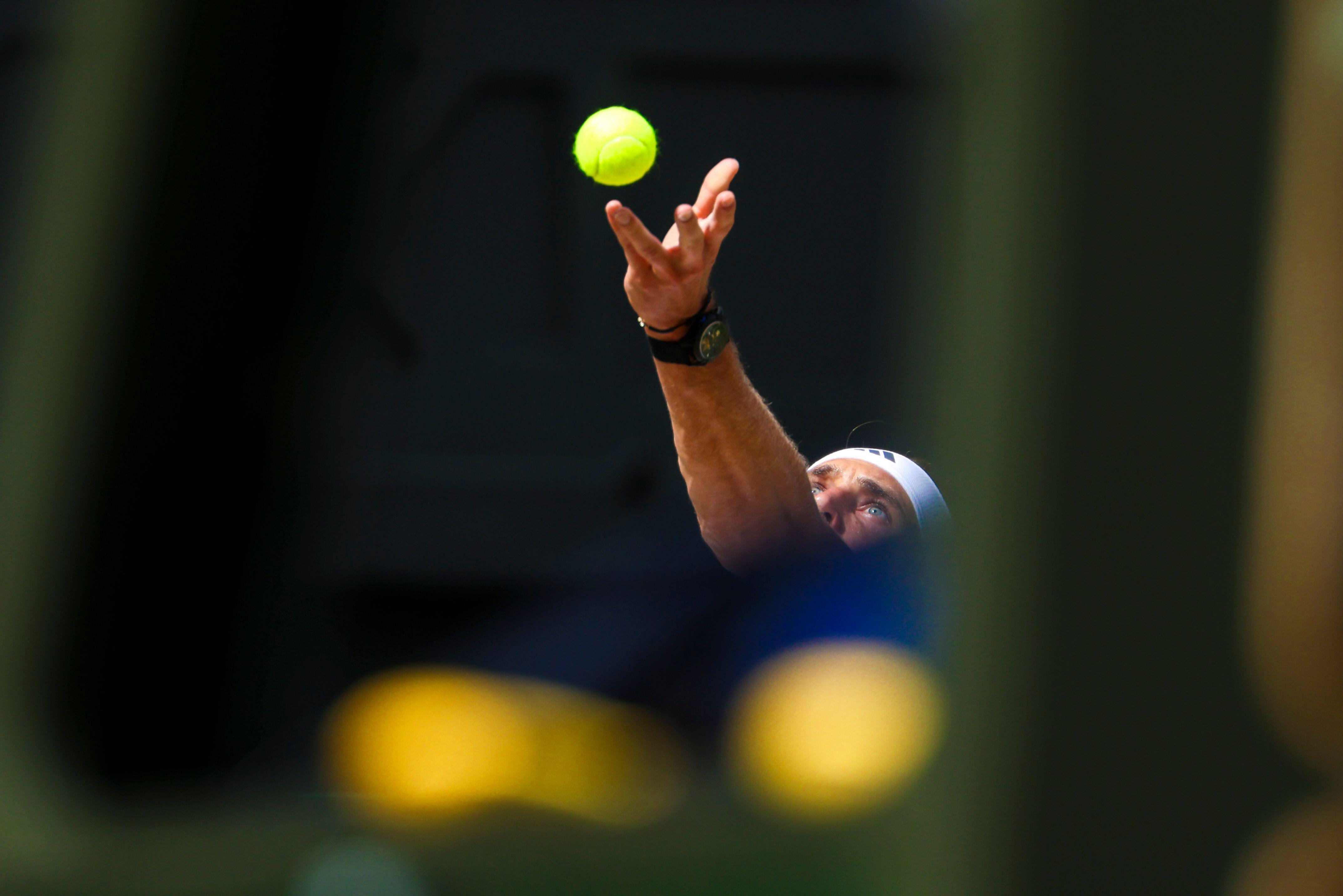
Second-seeded Alexander Zverev, who plays his first-ever Wimbledon final on Sunday afternoon against Jannik Sinner, is one of the main characters of the tournament, enjoying many hours of coverage on BBC broadcasts as he made his way through the draw as a newly-minted major champion in men’s tennis.
But no matter how many hours of tennis coverage they binge, BBC television audiences at home—many of whom watch tennis only during this fortnight—aren’t likely to hear the whole story about Zverev. That is, unless something dramatically changes in the network’s policy and practices toward a crucial aspect of Zverev’s biography, one that has stained his image among many tennis fans who follow the sport year-round.
First in 2020, and then again in 2023, Zverev was accused of physical and emotional abuse by two of his long-term former partners, Olya Sharypova and Brenda Patea. Zverev has offered repeated blanket denials to the detailed claims made by each woman.
Sharypova’s case was the subject of a “major independent investigation” commissioned by the ATP, which neither confirmed nor disproved the accusations against Zverev, but instead concluded in January 2023 that there was “insufficient evidence to substantiate published allegations of abuse.” Patea took her case to German authorities; in 2024, a court proceeding between Patea and Zverev ended in a settlement that had Zverev paying 200,000 euros (£170,000) in penalties, with 150,000 euros paid to the German treasury and 50,000 going to non-profit organisations.
The resolution did not determine Zverev’s possible culpability, however: “The decision is not a verdict and it is not a decision about guilt or innocence,” the court told media.
These are not niche concerns in Zverev’s profile: the two cases currently take up 11 paragraphs of his English-language Wikipedia page.
But BBC TV, like nearly all1 French Open broadcasters last month, has completely ignored this topic in all its coverage and discussion of Zverev at Wimbledon this year to my knowledge, even as he takes a more prominent role in the tournament than ever before, including his role as the opponent who ended Arthur Fery’s “fery-tale” run to the semifinals.
Yes, the BBC is proving it is possible to sportswash an athlete.
Any moment of Zverev coverage during this fortnight so far would be found similarly lacking, but let’s start with the introduction to his first-round match last Tuesday. The panel of Clare Balding, Tim Henman, Jamie Murray and Anne Keothavong was tasked with cueing up Zverev’s opening-round match on Centre Court. The group spoke of his winning the French Open after having previously lost three Grand Slam finals. They mentioned his ankle injury that happened four years ago. There was a long section, replete with graphics, on how Zverev’s second serve return position might have been a liability on grass last year. Then, the match began, and that became the sole focus of the commentators.
But the full picture is far more complicated, and I daresay more interesting. Uniquely among recent winners, the cloud from Zverev’s cases has still hovered over him in this new chapter he’s begun as a major champion, dimming the dazzling sparkle which newly-crowned champions customarily enjoy.
At least, anyhow, in print and online media.
The morning after his win in Paris, Zverev abruptly cut off an interview with French sports daily L’Equipe after reporter Quentin Moynet repeatedly asked him questions that alluded to the allegations. “I think we should stop,” Zverev said, abruptly halting the interview.
The two had been traveling in a car together for a ride-along interview on the way to Zverev’s trophy shoot near the Eiffel Tower. “The journey ended in an icy silence,” Moynet wrote of the final five minutes of the ride.
The aborted L’Equipe interview made headlines internationally, including in Zverev’s native Germany, where he remains a far less beloved figure than previous German champions like Boris Becker or Steffi Graf.
Raphael Brinkert, a German PR expert, was interviewed last month by the German newspaper Süddeutsche Zeitung about the continuing challenges Zverev faces abroad and at home.
“People respect him as a tennis player, but they do not love him,” Brinkert told SZ of Zverev. “There are too many issues hanging in the air for that…A public reckoning from him never really took place. As long as he does not clear up or clarify these issues, that will not change.”
This week in Britain, articles about the accusations against Zverev have run in outlets such as The Times of London, The Independent, The Press Association, The Sun, and even music magazine Far Out.
There’s no compelling reason that print audiences should be the only ones confronted with the full story about this complex character.
Given all of the erudite and thoughtful programming they do on their airwaves, the BBC, surely, thinks highly enough of its television audience so as not to withhold complicating information about one of the biggest stars of its signature sports event?
And in its recent programming on its other platforms, the BBC has proven more capable. On BBC Radio 5 Live, the allegations were discussed both before and after last month’s French Open final by BBC tennis correspondent Russell Fuller. The BBC website, too, has covered the stories around the allegations for years.
Alexander Zverev to face no disciplinary action after domestic abuse allegations - BBC Sport
Alexander Zverev’s domestic abuse allegations are ‘messy cloud’ for tennis - BBC Sport
Alexander Zverev domestic abuse case discontinued - BBC Sport
When reached for comment about this story, a BBC spokesperson referred to Fuller’s radio reporting and sent those links to four articles about Zverev’s case on the BBC website, without offering any explanation to my core inquiry: why BBC television audiences have been kept in the dark on this topic.
It’s also possible that something could happen on Sunday inside Centre Court that would foreground Zverev’s past, for which a television audience would have no context. After all, the last time Zverev and Sinner faced one another in a major final, the trophy ceremony was disrupted by a protester shouting the names of the women involved.
BBC Sport television audiences, occasionally, are exposed to microdoses of journalism. At the close of the halftime show during England’s World Cup group stage game against Ghana weeks ago, BBC presenter Gabby Logan ended the football discussion with a warning to the audience that she had “one news line” to report, before mentioning England’s Djed Spence not shaking hands with Ghana’s Thomas Partey pre-match, and then summarizing the seven rape charges and one sexual assault charge which Partey faces. “He’s denied the charges and is scheduled to go on trial next year,” Logan concluded.
Partey was one of 22 players on the pitch during that match, and there was still time in the broadcast to discuss his legal troubles; Zverev is one of just two players on court during his Wimbledon appearances, playing best-of-five singles matches that often last twice as long as a football contest.
I hold the BBC, as a public service broadcaster, to a higher standard than I do networks like ESPN or TNT—it would likely say the same of itself.
In its most recent Royal Charter, the BBC defines its mission as “to act in the public interest, serving all audiences through the provision of impartial, high-quality and distinctive output and services which inform, educate and entertain.”
Wimbledon would still “entertain,” probably, without a single word spoken by commentators. But in order to uphold the “inform” and “educate” promises of its commitment to the British public, the network must break its silence and make sure the audiences watching at home understand the shadows that darken the picture around this man dressed in all-white.
Thanks for reading Bounces. If you’d like to support the work I do here, please consider a free or paid subscription. -Ben
The one broadcaster whom I’ve heard discussed the accusations on a French Open broadcast last month was Danish commentator Anders Haahr Rasmussen.
Keep up the GREAT work you're doing Ben. Really appreciate your commentary and willingness to bring important issues like this to light. Another excellent article following your piece on Adidas and their gender disparity in sponsorship between the men's and women's players. Thank you. Thank you. Thank you! 🥇
Thanks for consistently covering this issue. Zverev is fast becoming, in the absence of Carlos Alcaraz, one of the dominant figures in the sport. He could have won his second grand slam in a row by the end of the day. That makes scrutiny and accountability ever more important. Sadly, not enough journalists are offering comparable scrutiny - Zverev has a habit of shutting off access or ending interviews to those who bring up the allegations against him.