


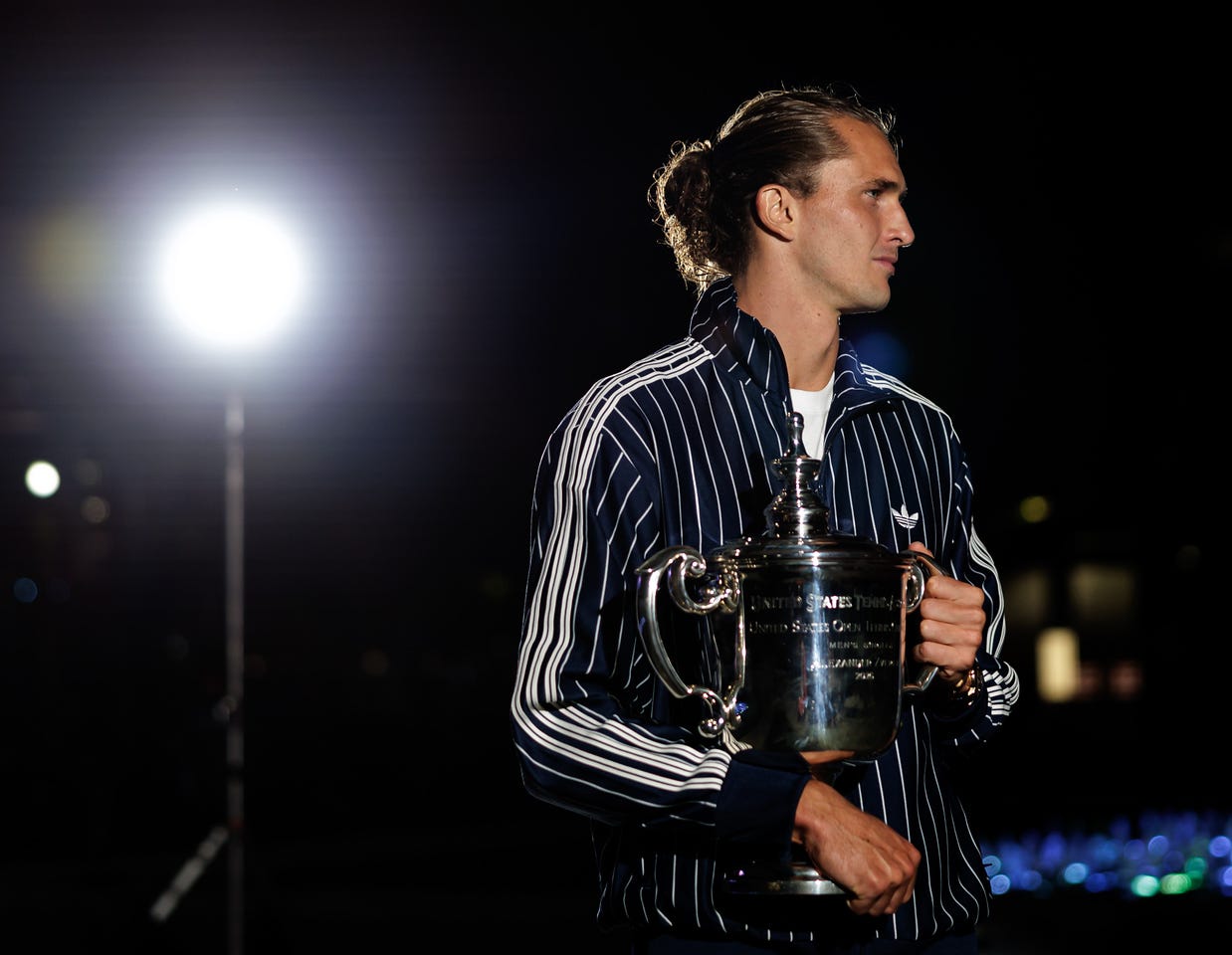
There’s big news to break here at Bounces about renewed legal trouble for the recently installed ATP No. 1, Alexander Zverev.
As he prepares to play the ATP Finals, the year-end championship event which begins this Sunday in Turin, Zverev faces a new civil lawsuit filed by Brenda Patea, an ex-girlfriend who is the mother of his five-year-old daughter.
Bounces can report exclusively that the previously unreported suit, filed September 18th in Berlin, centers around false statements Zverev made in June in an interview with L’Équipe. In that interview, Zverev mischaracterized the resolution of a court case with Patea two years earlier, claiming that his “innocence has been proven.”
This has been a long saga, so before getting into the new developments, I think a reminder of previous events would be helpful.
Background
Patea had been the second of two ex-girlfriends to accuse Zverev of having been physically abusive during their relationship; Zverev has consistently made blanket denials of all of the accusations of abuse he’s faced from both Patea and his previous ex-girlfriend, Olga Sharypova.
After Patea brought her case to authorities in Germany, it eventually led to a penalty order being issued to Zverev in October 2023, assessing a fine of 450,000 euros.
“He is charged with having pressed the witness and joint plaintiff, Brenda Patea, against the wall and having strangled her with both hands, causing her to experience shortness of breath and suffer considerable pain,” the court records about the penalty order read.
When Zverev contested that penalty order, a criminal trial was held in May and June of 2024, during that year’s French Open. While Zverev played and reached the final in Paris, his lawyers in Berlin portrayed the mother of his daughter as “a liar who was motivated by fame and fortune,” according to a report by DW. A request by Zverev’s lawyers that Patea’s testimony be held behind closed doors was granted.
The proceedings ended before Patea’s cross-examination, and before any verdict of guilt or innocence.
“We applied for the settlement,” Kristin Hartmann, one of Patea’s lawyers at the time, told DW. “The daughter was really suffering. So now they can both look to the future and get on with their lives. We ended this deal with [the feeling] that people should stop throwing things at each other.”
The court told the BBC that “the decision is not a verdict and it is not a decision about guilt or innocence.” As a condition of the closure, Zverev paid 200,000 euros to the court and a charity fund.
The hearing ended the same day as Zverev won through to the final at Roland Garros. At his post-semifinal press conference, the BBC’s Russell Fuller asked Zverev if there were “any reservations on your part that you came to a settlement and that you didn’t have a chance for the court in Berlin to say that you were innocent of all the charges?”
Zverev rejected the suggestion and falsely claimed otherwise before audaciously declaring the matter closed.
“That’s what dropping the case is: that is innocence,” Zverev said. “They’re not going to drop the case if you’re guilty at the end of the day. I don’t know what translations you have, but that’s what it means. Done. We move on. I never ever want to hear another question about the subject again. That goes out to everybody.”
For the most part, tennis media heeded Zverev’s demand: he’s rarely been asked about the accusations since. The sport’s establishment—and particularly rights-holding television broadcasters—have seemed eager to move on and forget this complicating chapter of Zverev’s biography.
But even without active discourse, there has still been considerable discomfort around Zverev and these unresolved accusations in many corners, particularly among fans, including a protester at the 2025 Australian Open’s trophy ceremony.

When Zverev marched through a broken draw to win his long-awaited first major title this year at Roland Garros, it was a downbeat occasion for many. I wrote about the somber print coverage of the event, including in French media.

Admirably, L’Équipe reporter Quentin Moynet asked Zverev about this tension in an interview the morning after the final, as I wrote about that week. Let me now quote generously from that June Bounces report on the Zverev-Moynet interview, because it is pivotal to this new case.

On the Monday morning after the final, L’Équipe reporter Quentin Moynet joined Zverev in a car for a ride-along interview on the way to his photoshoot with the trophy near the Eiffel Tower.
“We are neither prosecutors nor judges, but we observed a certain unease after Alexander Zverev’s victory on Sunday at Roland Garros, and heard the legitimate questions about how to report on it,” Moynet began his article, before describing an interview that was “initially quite warm and cheerful but quickly turned sour.”
As the interview began, Moynet asked Zverev about a dozen questions without issue, on topics including the sleepless night of celebrations that followed his win, serving as a possible inspiration to kids with diabetes, and his desire to play for another 10 years.
But then Moynet asked about the woman, known on Bounces as Nina, who had shouted “Australia believes Olya and Brenda!” during last year’s Australian Open trophy ceremony.
Did Zverev remember this moment, Moynet asked?
“Yes.”
Did he fear it could happen again in Paris?
“No.”
After asking about the support he’d received from the Parisian crowd, Moynet asked Zverev about the consternation in the press room about how to handle his win, “given the domestic violence allegations against you several years ago.”
Zverev, Moynet said, cut him off mid-question this time.
“Hold on,” Zverev said. “First of all, this isn’t that kind of interview. Secondly, you know that the accusations have been proven false?”
(Ed.: Though he has consistently denied them, the accusations have not “been proven false.”)
“The question is not directly related to the accusations,” Moynet suggested.
“This is the second time you’ve asked me about this,” Zverev replied.
“The question is: do you find it unfair that the media continue to talk about it?” Moynet continued.
This time, Zverev’s agent Sergei Bubka Jr. piped up.
“That’s a question about the accusations,” Bubka said.
Moynet then used his own paper’s reticence as proof that the topic was valid.
“L’Équipe, for example, didn’t dedicate its entire front page to you,” Moynet said.
“That wasn’t my decision,” Zverev said. “I did everything I could, and my innocence has been proven.”
(Ed.: Zverev’s innocence has not “been proven.”)
Moynet then tried moving on and changing topics, asking Zverev about his plans for the next few weeks.
Zverev sighed with annoyance and didn’t answer that benign question, either.
“I don’t know,” Zverev said. “I think we should stop. It’s better that way.”
Zverev did not speak again and the car fell silent for the final five minutes or so of the ride.
“Between dark looks and cutting remarks, his entourage, present in the vehicle, clearly disapproved of our approach, and made their displeasure known,” Moynet wrote. “The journey ended in an icy silence.”
Those parenthetical corrections to Zverev’s false statements were mine: they felt journalistically necessary in presenting his remarks to Bounces readers, so as not to let his falsehoods stand.
The L’Équipe interview—and the dramatic way in which Zverev abruptly ended it—garnered global coverage, including in Germany.
A New Case in Berlin
The legal proceedings in their case had been dormant for more than two years, but Zverev’s repeated assertions that the accusations against him had been “proven” to be lies moved Patea to act.
According to her complaint, Patea’s new Munich-based lawyer Michael Scheele sent a letter to Zverev on August 6th in which she “politely reminded the defendant of the obligation to refrain from such statements” and “asked him to confirm whether he had made the statement as quoted” by L’Équipe.
“The defendant did not respond to this letter,” Patea’s suit says.
Subsequent letters were also sent on August 11th and August 25th.
“The defendant did not respond to this either,” Patea’s suit says.
Patea initially applied for a preliminary injunction.
“The purpose of the application for a preliminary injunction was to ‘reduce’ the risk of repetition while the U.S. Open was still underway,” Patea’s suit says. “There was reason to fear that the respondent, particularly due to his outstanding performance in that tournament, would once again make the disputed claims in the foreseeable numerous interviews.”
But no one asked Zverev about the accusations this time, as far as I have found, and no false statements were made in reply.
During the U.S. Open World Feed’s broadcast of the men’s final, recent Hall of Fame inductee Mary Carillo discussed Zverev’s previous statements.
“Two different women, one of whom is the mother of Zverev’s daughter, accused Zverev of domestic violence, an accusation he’s vigorously denied,” Carillo told viewers before calling out Zverev’s repeated mischaracterizations of his cases. “‘My innocence has been proven,’ he has said—that’s not true. ‘I was exonerated,’ he said—that’s not true. And all of this came up again, of course, when he won this year’s French Open.”
Patea withdrew the preliminary injunction on September 14th and filed a claim seeking injunctive monetary relief on September 18th, five days after Zverev’s U.S. Open win. The lawsuit notes that she had initially hesitated to take Zverev to court because “she feared reprisals from the defendant and anticipated that he would be less willing to settle regarding the child support claimed out of court.”
In the suit, Scheele contends that, in saying that “the accusations have been proven false,” Zverev was not presenting an opinion:
“The contested statement is to be classified as an assertion of fact. The defendant does not merely give the impression that he considers himself innocent or assesses the status of the proceedings as favorable to him. Rather, he conveys the statement—presented as an objectively established fact—that his innocence in the criminal proceedings has been proven. The term ‘proven’ is regularly understood, in the context of criminal proceedings, as referring to an objective finding verified either legally or factually. The statement is therefore subject to verification of its truth. It does not constitute a mere expression of opinion or a purely subjective self-assessment…
“…The assertion is untrue. There is no court order establishing the defendant’s innocence, no final acquittal, or any other decision with corresponding content.”
Scheele also contends that, because of Zverev’s false suggestion that Patea had been proven to be lying about her abuse claims, Patea suffered damage under the German legal concept of personality rights:
“The assertion significantly infringes upon the plaintiff’s right to social standing. In the context of criminal proceedings, she is associated with the allegation of assault. The assertion suggests that the plaintiff wrongfully accused the defendant or initiated unfounded criminal proceedings. This gives rise to a significant risk of social degradation, loss of reputation, and stigmatization of the plaintiff. The claim for an injunction against a false assertion requires that the contested statement infringe upon the affected party’s right of personality.”
Scheele wrote that Patea is seeking monetary compensation in this suit which “serves both to provide satisfaction to the plaintiff and to prevent further infringements” from being committed by Zverev.
“In the present case, a serious infringement has occurred,” Scheele wrote. “The defendant made a false factual assertion to an international newspaper that his innocence had been proven. This statement was disseminated internationally and picked up by numerous German media outlets. It discredits the plaintiff as a liar and portrays her as a person who wrongfully accused the defendant. Furthermore, the defendant has breached a contractual obligation to refrain from such conduct, which makes the motive and degree of his fault particularly egregious. The harm cannot be satisfactorily remedied in any other way, since the defendant, despite repeated requests has not issued a cease-and-desist declaration subject to a penalty, and thus even a cease-and-desist order alone cannot compensate for the harm that has already occurred and continues to have an effect.”
The suit was filed on September 18th but has not yet been formally served to Zverev.
Christian Schertz, Zverev’s lead media lawyer, replied to Bounces that “as a lawsuit has not even been served yet, we are unable to comment on the matter at all.”
Schertz suggested that my reporting on the issue was similarly premature: “Against this backdrop, any reporting on this matter is clearly and absolutely out of the question,” he wrote.
Though the clock has not yet started on Zverev’s reply, the lawsuit has already been received and processed by the court in Berlin, and has a case number. The court has also already issued a procedural order on next steps for the case on November 5th.
Zverev, whose personal email was cc’ed on my email to his attorneys, has not responded by the time of publication.
In an interview, Patea’s attorney Michael Scheele told Bounces that the L’Équipe interview jumped out at him when he began representing her, initially on child support matters.
“When I had a look at all the files that she brought, I found this interview and I said, ‘But why didn’t you go against it?’” Scheele said. “She said, ‘Well, I didn’t have the means to engage a lawyer and I didn’t know how to go about it.’”
Scheele was clear that, legally, suspicion and uncertainty can remain around the case, despite how Zverev describes it.
“He actually seems to believe that his innocence was proven in the proceedings; otherwise, he probably wouldn’t have said so in the interview with L’Équipe,” Scheele said of Zverev. “We must therefore make it clear: Yes, he was not convicted, but it is also true that he was not acquitted. There is still suspicion of a crime, which he has not been able to dispel.”
Scheele expressed frustrations that tennis commentators have discussed the matter as more cleanly resolved than it is.
“That is, of course, nonsense,” Scheele said. “The matter was not resolved in court—at least not in the sense of an acquittal. And since Mr. Zverev is known to react very impulsively at times, it must be made clear to him—through the threat of legal sanctions—that the dismissal of the criminal proceedings in exchange for a payment of 200,000 euros does not constitute an acquittal. Incidentally, he has paid that amount.”
Scheele confidently said his chances of winning this case were “100 percent.”
“Look at the facts: what he said was a lie,” Scheele said of Zverev. “And it’s not a lie because I call it a lie. The legal definition of what has happened i:s he is not convicted guilty and he is not found not guilty. And since this is the case, he cannot say that it has been proven that he’s not guilty. That’s a fact, you know?
“And why do you think [Zverev’s lawyer] Mr. Schertz is silent?” Scheele continued. “Why does he refuse to be served this suit? Because he doesn’t know what to do against it. So he’s only delaying. It. And once it is in court, he will lose. If he doesn’t give in, he will lose. The only question that is not yet answered—and this is what we have to wait and see—is if he has to pay punitive damages for infringing with the law.”
Patea’s lawsuit specifically relates to the L’Équipe interview, but Zverev’s pattern of false or misleading statements about the legal outcomes of his cases predates that considerably, and I will follow up with more on that pattern here soon.
Rather than suing his ex-partners for their statements alleging abuse, Zverev has reliably aimed his legal wrath at the reporters and outlets covering the accusations. My own years-long case with Zverev in Berlin was mostly resolved1 in November 2025, ending with a judge’s mixed decision in an appeals court. In short, the court enjoined me from reporting in Germany about specific details relating to Olga Sharypova’s claims of physical and emotional abuse, but did not prohibit me from reporting her mental state around the time of the allegations. Nor did the decision prohibit me in any way from reporting on Patea’s case.
Thanks for reading Bounces. If you’d like to support the independent tennis journalism I do here, please subscribe. —Ben
We are, frustratingly, still waiting for the final bill from the court about fees and costs and reimbursements and such, nearly a year later.
Glad to hear Patea hasn't been effectively silenced and is able to fight back against that guy. And kudos to you, Ben, for continuing to report on this topic.